Want to learn how to play pickleball? You’re definitely not the only one. Pickleball is one of the fastest growing sports and it’s easy to see why. It is simple to pick up and incredibly fun to play. This beginner’s guide covers how to play pickleball, with the basics broken down so you can start playing confidently in no time.
We’ll walk you through the essential rules, scoring system, basic mechanics, mistakes to avoid, and gear you’ll need to start playing today.
What is Pickleball?
Pickleball is a paddle sport that blends elements of tennis, badminton, and ping-pong. It’s played on a small court with a solid paddle, a lightweight plastic ball with holes in it, and a low net. You can play singles pickleball with two players (one-on-one) or doubles pickleball with four players (two-on-two), with doubles being the preferred format for most recreational games.
The appeal is how quickly you can pick it up. The court is small, the ball moves slowly, and the rules are simple enough to learn in a single afternoon. That’s a big part of why it’s become one of the fastest growing sports around. It’s easy to start and genuinely fun from your very first game.
Below, we’ll walk through exactly how pickleball is played, step by step. Now let’s get you ready.
Equipment: What You Actually Need to Start Playing
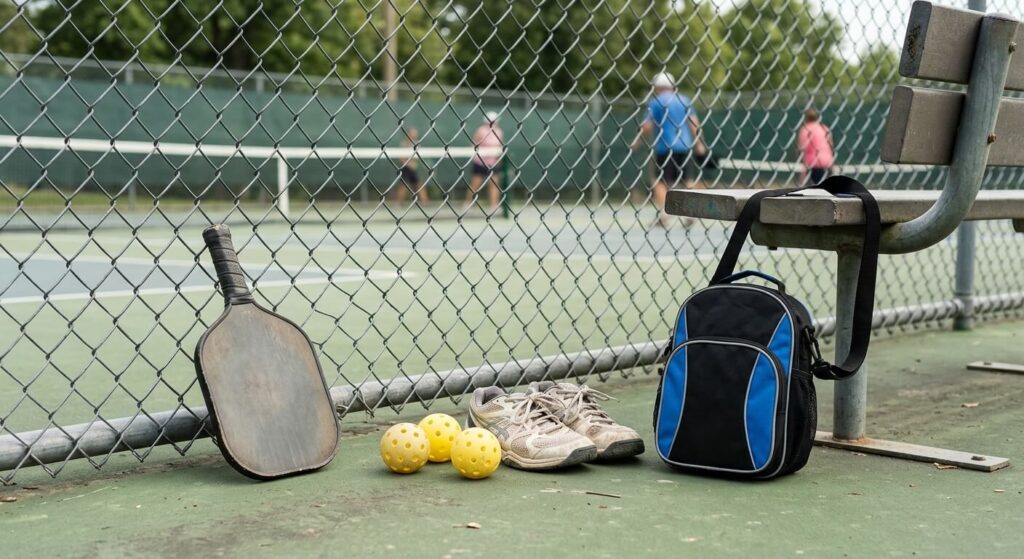
If you’re wondering how to start playing pickleball, the good news is it’s one of the quickest and most affordable sports to get into, and you don’t need much for your first game.There are three pieces of equipment to think about, and you can borrow most of them to start.
- Paddle: Pickleball paddles are solid, graphite or carbon fiber at the quality end, composite or wood at entry level. For your first paddle, you don’t need to spend more than about $50. Skip the rock-bottom $10 to $20 paddles, which tend to feel dull and dead, and skip the $200 pro paddles you won’t appreciate yet. A mid-range paddle in the $40 to $50 range gives you enough control to actually feel the difference between a good shot and a bad one. The finer details (weight, grip size, surface texture) matter more once you’re playing regularly.
- Ball: Pickleball balls come in two types. Outdoor balls are harder with smaller holes, and indoor balls are softer with larger holes. They’re inexpensive and usually come bundled with a set, so this isn’t something to overthink.
- Court Shoes: Optional to start, but worth it sooner than you’d think. You can absolutely use regular sneakers for your first few games, but pickleball involves a lot of quick lateral movement, which running and walking shoes aren’t built for. Court shoes offer more cushioning and side-to-side traction, support those lateral cuts, and lower your risk of rolling an ankle. The difference is noticeable within a single session.
The easiest way to start is a beginner set, which bundles your paddle and balls together. A solid two-paddle set with a couple of balls usually runs about $50 to $80, and step-up sets from name brands (often with a carry bag included) land closer to $100 to $130. Grabbing a two-paddle set is also the simplest way to talk a friend or partner into playing with you.
Tip: Most public courts or recreation centers offer free sets to borrow so if you’re just testing out the sport you won’t have to spend a dime to see if you like it!
The Court
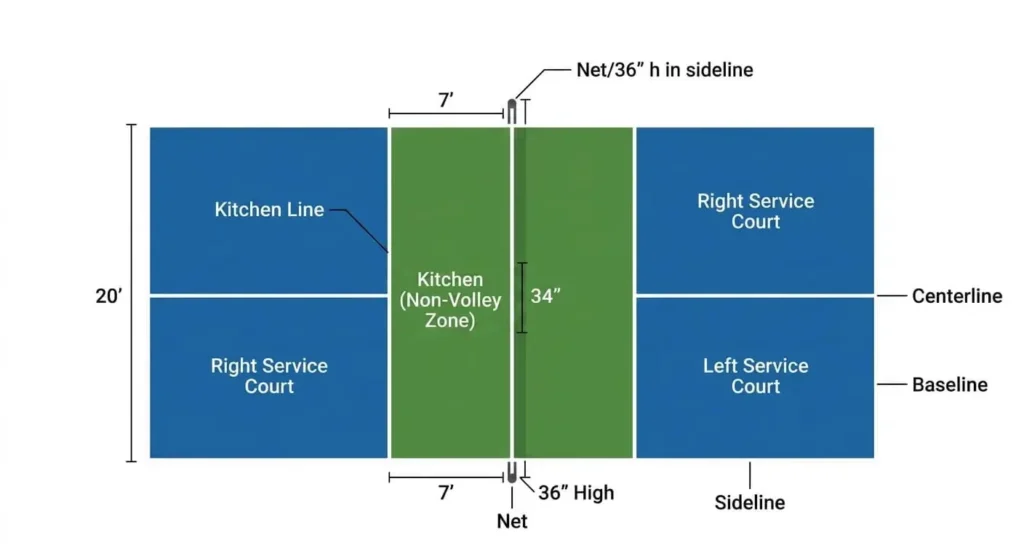
Before you can start playing, let’s break down the court itself.
A pickleball court is 20 feet wide and 44 feet long, and the net sits at 36 inches on each side and 34 inches in the center.
Unlike other sports, the size of the court does not change regardless if you’re playing singles or doubles.
The most important part of the court to understand immediately is the non-volley zone, which is almost always called the kitchen.
The kitchen extends 7 feet from the net on both sides and runs the full width of the court. You cannot hit the ball out of the air (volley) while standing in it. You can enter the kitchen to play a ball that has bounced inside it, but you cannot stand in there and smash volleys.
The kitchen exists for a reason: without it, whoever rushes the net first would win nearly every rally. The kitchen forces strategic play, soft shots, and patience.
Kitchen line rule: The kitchen line itself counts as part of the kitchen on volleys. If any part of your foot touches the line while you hit a volley, it is a fault — even if you step out immediately after.
The Essential Rules for Your First Game
There are dozens of pickleball rules, but four cover almost everything that happens in a real game. Learn these and you can play correctly on day one.
Rule 1: The Underhand Serve
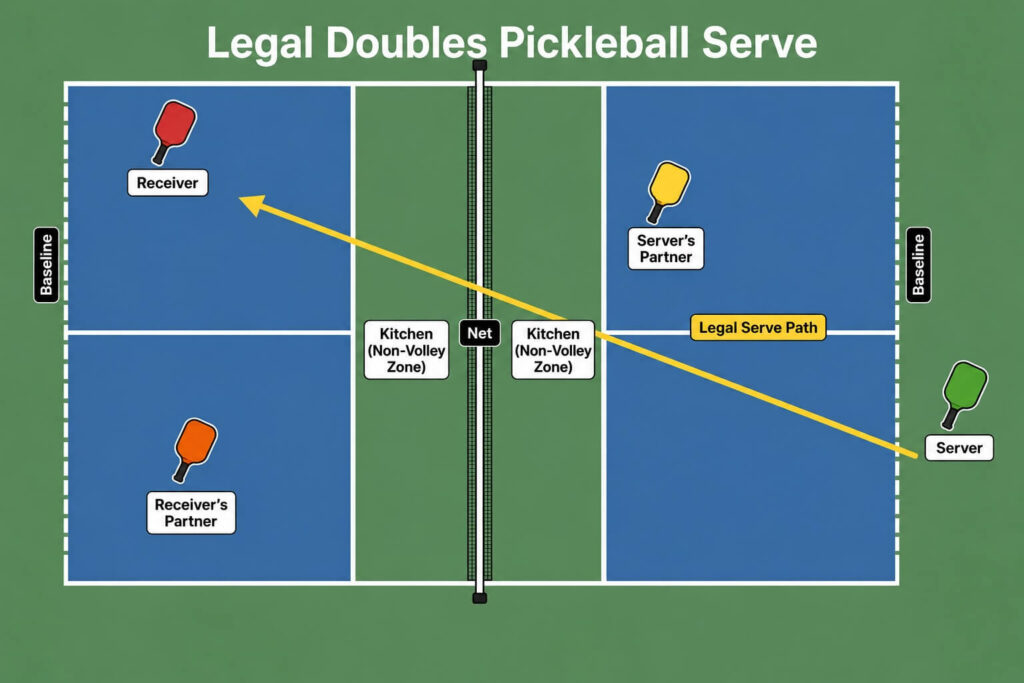
Pickleball uses a unique underhand serve, and understanding the requirements is key to avoiding easy faults.
- All serves must be hit underhand and contact the ball below the waist. The paddle head also needs to stay below the wrist at contact.
- You serve diagonally to the opposite service box
- The serve must clear the kitchen and land in bounds. A serve that lands on or in the kitchen is a fault
- You serve from behind the baseline, feet cannot touch the baseline or sideline
There are two legal serve types:
Volley serve: the traditional serve, hit out of the air before it bounces. This is what you’ll see 95% of the time.
Drop serve: you drop the ball and let it bounce before hitting it. No restrictions on arm motion or height for a drop serve. Easier for beginners to learn.
Start with the drop serve. It has fewer technical requirements and you’ll put the ball in play consistently from your first session.
Serving strategies worth knowing early:
- Serve deep and try to keep your opponent pinned at the baseline, away from the kitchen
- Target their backhand side if you know it’s weaker
- Don’t try to ace anyone in casual play, consistency matters far more than power
Rule 2: The Two-Bounce Rule
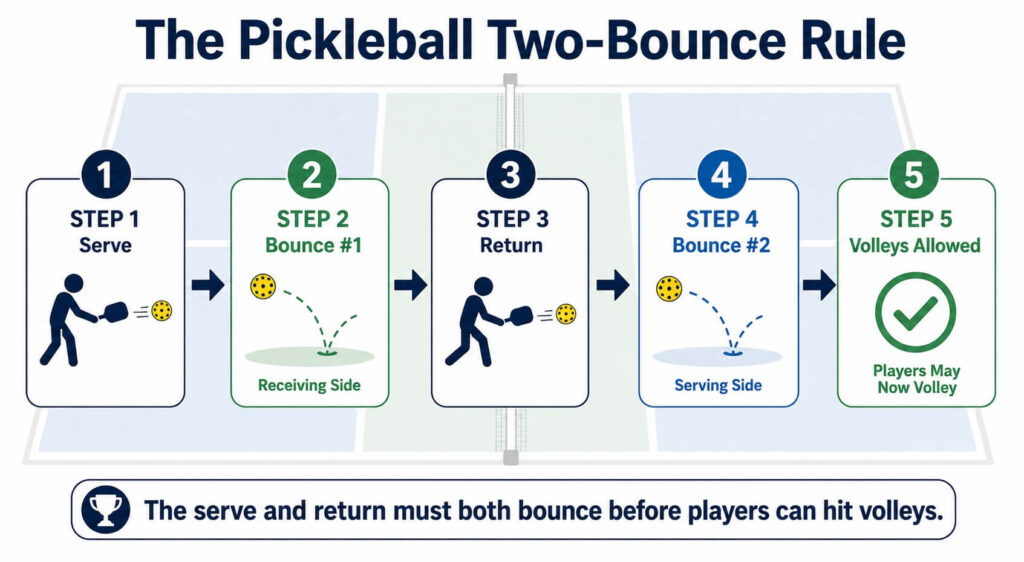
Pickleball’s two-bounce rule requires the ball to bounce once on the receiver’s side and once on the server’s side before either team can volley the ball (a volley is when the ball is hit out of the air before the bounce).
The sequence looks like this: serve → bounce on receiver’s side → return → bounce on server’s side → now either team can volley. Once those two bounces happen, the rally is wide open. You can hit the ball in the air or let it bounce, whatever works best for you.
The two-bounce rule is important because it eliminates the serve-and-volley advantage and helps extend rallies. Without it, the serving team could rush the net immediately and attack the return out of the air.
The receiving team can start moving to the kitchen after returning the serve, because the ball will always bounce again on the server’s side before it reaches them
Common beginner mistake: Standing at the kitchen line when you’re on the serving team, then trying to volley the return. That’s a fault because the return hasn’t bounced yet. Stay back after serving until the ball bounces on your side.
Rule 3: The Kitchen (Non-volley zone)
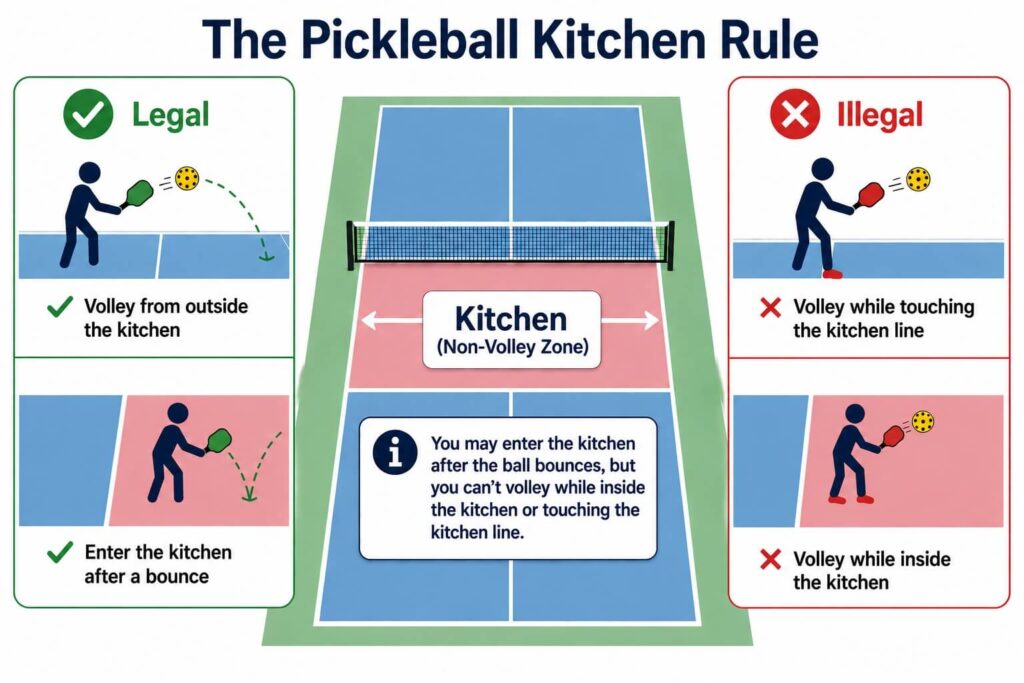
You’ll immediately notice the 7-foot zone on each side of the net. That’s the kitchen, officially called the non-volley zone. The pickleball kitchen rules prohibit you from hitting a volley while standing inside it. Your feet can’t touch the kitchen line either, that counts as being in.
This is the most common beginner violation, bar none. You’ll see the ball floating right in front of you, step into the kitchen to smash it, and realize too late you just committed a fault. It happens to everyone in their first few games.
You can enter the kitchen before, during, or after a rally and stay as long as you want. You just can’t volley from inside it.
The momentum rule: if your volley sends your momentum forward and you step into the kitchen after making contact, that is still a fault.
Rule 4: What Ends a Rally (Faults)
A rally ends when someone commits a fault. The most common ones you’ll see:
- Ball lands out of bounds (behind the baseline or outside the sideline)
- Ball hits the net and doesn’t cross over
- Ball bounces twice before being returned
- Volleying from inside the kitchen or on the kitchen line
- Serve lands in the kitchen or on the kitchen line
- Violating the two-bounce rule (volleying before both sides have had a bounce)
- Foot fault on the serve, which happens when you step on or over the baseline while serving
Important line rule: All lines are considered in during regular play, except the kitchen line on a serve, which is out. A serve that clips the kitchen line is a fault. Any other shot that clips any other line is in.
Understanding Pickleball Scoring and Rotations (The 3-Number System)
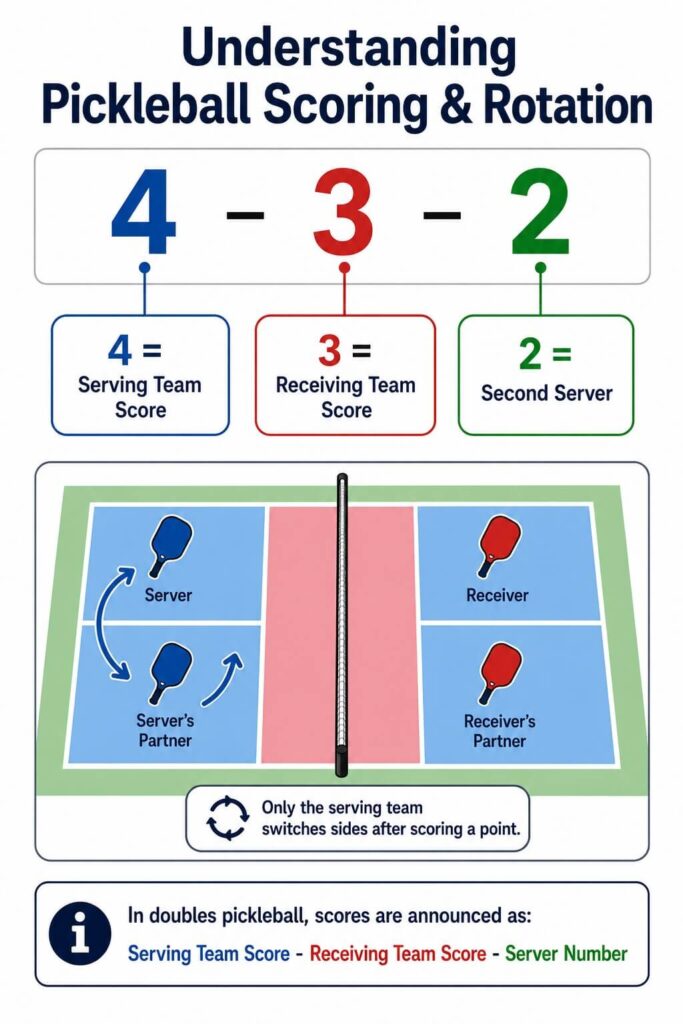
Pickleball’s three-number scoring system trips up almost every beginner and seems strange at first, but here’s the breakdown.
The basics:
- Only the serving team can score points
- Games are played to 11 points and you must win by 2. The game will continue until one side wins by two points
- Server calls out the score before each point
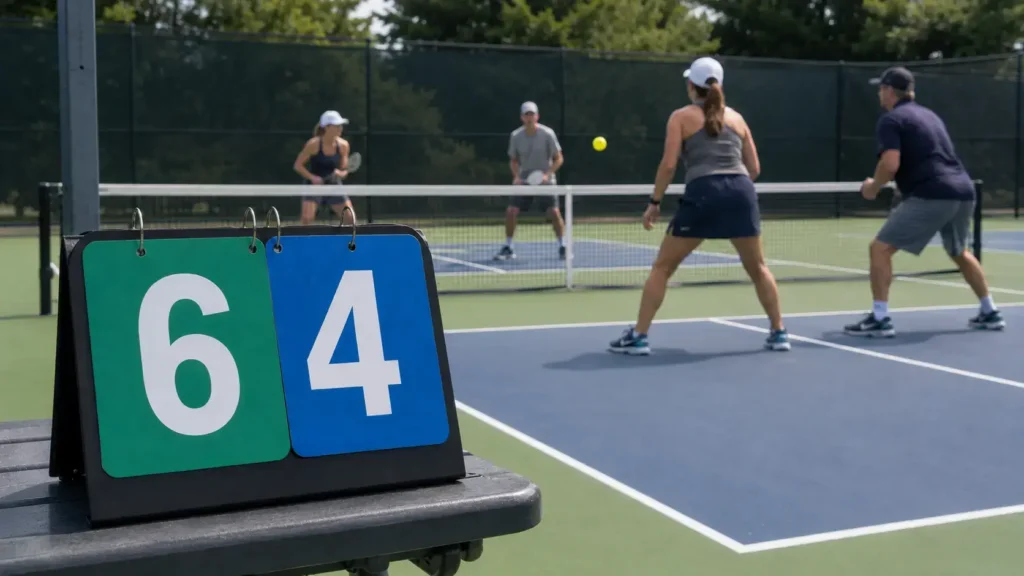
- In doubles, the score is called as three numbers before every serve
What the three numbers mean:
Let’s use example score “4 – 3 – 2”
First number = serving team’s score (4)
Second number = receiving team’s score (3)
Third number = which server on the serving team is currently serving (2)
So when you hear “4 – 3 – 2” it means the serving team has 4 points, the receiving team has 3 points, and server 2 on the team is currently serving.
How rotation works:
The first server is typically determined by a coin toss, paddle spin, or another mutually agreed method. The winner chooses whether to serve first or select a side of the court.
In doubles, each team member gets to serve before the serve passes to the other team. The same player continues serving as long as their team keeps winning rallies and scoring points. When the serving team loses a rally, the serve passes to that player’s partner. If the partner then loses a rally while serving, it’s a side-out, and the other team gets the serve.
After winning a point on your serve, you switch court sides with your partner (left to right or right to left). The serve then goes diagonally to the opposite court.
Worked Out Example: The score is 3–3. You’re the first server on your team. You call: “3 – 3 – 1” and serve. You win the point → score is now 4–3. You switch court sides with your partner and you continue to score. You call: “4 – 3 – 1” and serve again. You lose the rally → your partner now serves. Your partner calls: “4 – 3 – 2” Your partner loses the rally → side-out. The other team serves. They call: “3 – 4 – 1” (their score first now, because they’re serving)
The “0-0-2” question:
Every new player asks why the first serve of a game starts at “0-0-2” instead of “0-0-1.”
The reason: the starting team gets only one server at the beginning of the game (to prevent an unfair advantage from going first). Calling “2” signals this exception and when that server loses a rally, it’s immediately a side-out. No second server on the opening rotation. After the first side-out, normal two-server rotation resumes for both teams.
Singles scoring: In singles, only two numbers are called (your score, then your opponent’s). You serve from the right side when your score is even, left side when your score is odd.
Common Shots: What to Actually Hit and When
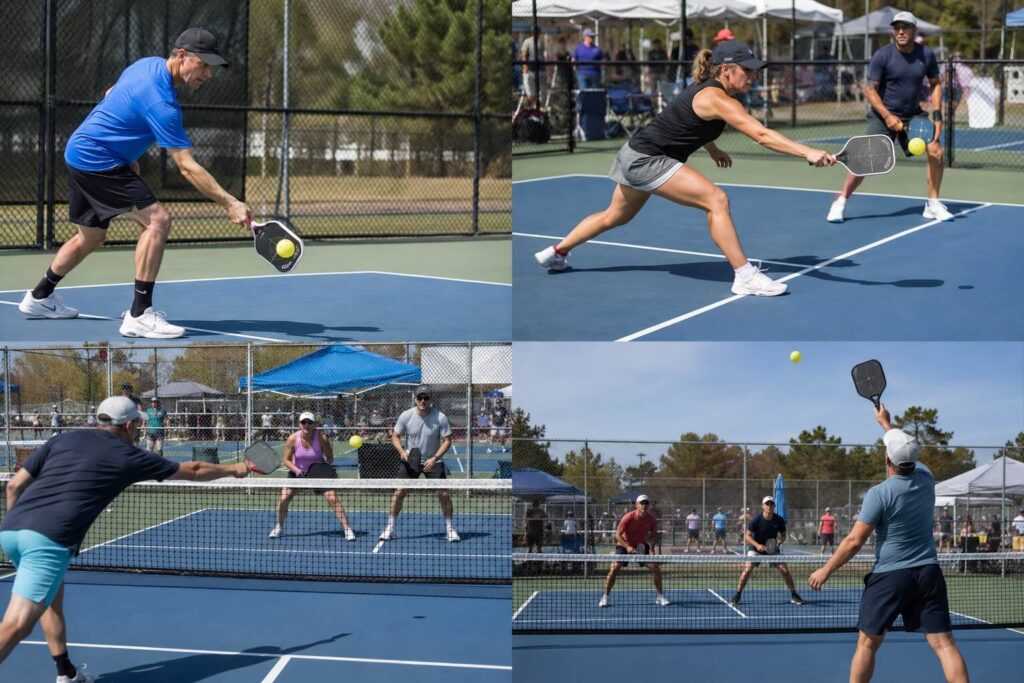
You don’t need 10 crazy shot types to be useful on a pickleball court. There are five primary shots you will use during a casual game plus a couple additional ones you might encounter and should learn as you get more advanced. Here they are in order of when they appear in a rally.
1. The Serve
During your first games, the only goal of the serve should be to get it in bounds. That’s it. Don’t try to ace anyone. Deep and in bounds beats hard and out of bounds every time. As you improve, add depth and target their backhand. Spin serves are advanced and you can save learning them until later.
2. The Return of Serve
This is more important than most beginners realize. Try to hit it deep. A deep return forces the serving team to stay back at the baseline while you advance to the kitchen. A short return hands them an easy transition ball and lets them move forward. Deep returns are free pressure.
3. The Third Shot Drop
The third shot drop is one of the most important shots in pickleball, and one of the biggest separators between beginner and advanced players.
After the serve and return, the serving team is usually stuck near the baseline while the receiving team has already moved to the kitchen line. The third shot drop is a soft, controlled shot hit by the serving team that arcs over the net and lands in the opponent’s kitchen. Since the ball lands softly and bounces low, it forces the opponents to hit upward instead of attacking aggressively.
A good third shot drop gives the serving team time to move from the baseline toward the kitchen and neutralize the receiving team’s positional advantage. A poor drop, one that’s too high, too deep, or falls short of the kitchen, often gets attacked immediately.
This shot takes weeks to develop and months to trust under pressure, but mastering it will improve your game faster than almost any other skill.
4. The Dink
A dink is a soft shot hit from near the kitchen line that lands in the opponent’s kitchen. It’s unattackable when placed well. A low dink forces your opponent to hit upward, and upward shots from the kitchen give you something to attack.
Dinking is not passive. It’s deliberate pressure. Most beginner rallies are decided by who starts dinking first versus who keeps driving and eventually makes an error.
5. The Volley
Volleys are hit out of the air from the kitchen line, using a compact punch motion, not a big backswing. The player who controls the kitchen line and consistently puts away volleys wins most recreational games. Fast hands and a stable ready position matter more than power.
Other shots you’ll encounter:
- Lob: hit high and deep to push opponents away from the kitchen. Use sparingly; on a small court, a bad lob is an easy overhead.
- Overhead: the answer to a lob. Hit above your head with a tennis serve motion. Drive it into the open court.
- Drive: a flat, hard groundstroke from the baseline. Useful for applying pressure but risky from mid-court against players in the kitchen.
Singles vs Doubles Pickleball
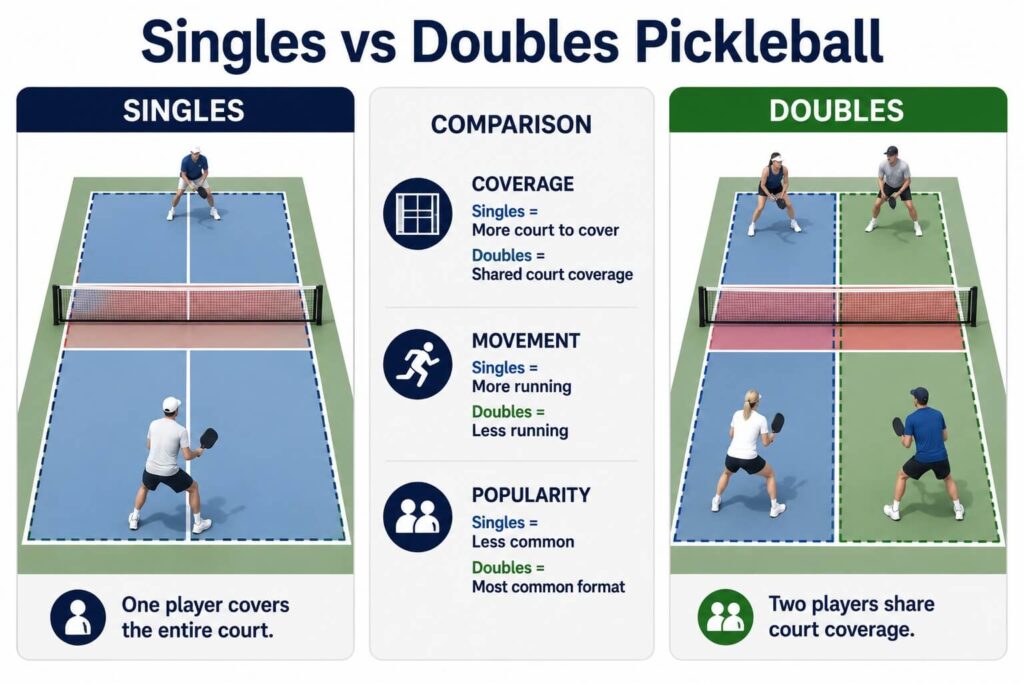
Most people learn pickleball in doubles which is played with four players, two per side. It’s the dominant format at every level from recreational to professional since it’s easier for beginners, less physically demanding, and what makes pickleball such a social sport.
Doubles: Two players share a side of the court and communication matters. Both players on the serving team stay back at the baseline until the two-bounce rule is fulfilled, then they can move up. The receiving team’s non-returning player can start at the kitchen if they’d like. The goal is to get both players to the kitchen line as quickly as possible and dinks are heavily relied on.
Singles: One player per side but the same court, same rules. More physically demanding since you’re responsible for coverage of the entire court by yourself and players often hit deeper serves and returns and more passing shots are used. Serving rotation is simpler and you serve until you lose the rally.
Unlike other sports, the core rules are essentially the same in singles and doubles:
- Same court dimensions.
- Same kitchen (non-volley zone) rules.
- Same serving rules.
- Same double-bounce rule (the receiving team must let the serve bounce, and the serving team must let the return bounce).
- Same faults and line calls.
The main differences are:
1. Serving and score calling
- Singles: One server per side. Lose a rally while serving and the serve immediately goes to your opponent.
- Doubles: Two servers per team (except at the start of the game), creating the serving rotation
2. Where you serve from
In singles, the server’s position is determined entirely by their score:
- Even score → serve from the right side.
- Odd score → serve from the left side.
In doubles, players switch sides with their partner after scoring, so tracking who serves from which side is more involved.
If you’re just starting, play doubles. The shared court coverage is more forgiving, the social element is better, and the kitchen battle is where the game actually lives.
Where to Play Your First Game
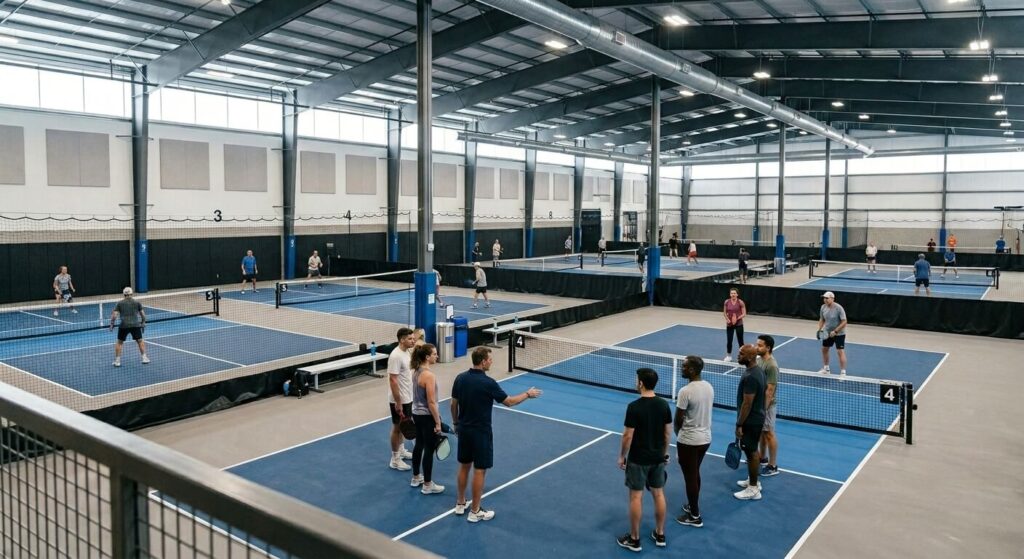
As pickleball rises in popularity, so does the number of places to play. Many towns have installed pickleball courts in their parks or recreational areas. These courts are free to use and sometimes have organized “beginner hours” or “open play for all levels.” Many will even offer pickleball paddles and balls to borrow for free if you want to try the game before investing money.
If you’d prefer to play inside, or are looking for organized lessons or matches, there has been a huge increase in indoor pickleball clubs and facilities. Many of these cost a monthly or yearly membership fee, but they offer lessons, clinics, leagues, and free play.
Indoor facilities are a great place to meet other people interested in the game and find people to play with at your same level. In addition to open play time, many locations offer targeted clinics and lessons for players at all levels, from complete beginner players just stepping onto the court for the first time, to advanced players training to play competitively.
For players who enjoy competing, these clubs usually host in-club leagues or travel leagues for you to play competitively. You’ll be matched with other players according to level and play matches each week to move up and down in the league standings. Usually the leagues will have different groups based on skill level, so players from all experience levels are welcome.
Beginner clinics vs. open play? If you’ve never held a paddle, a clinic is the easiest way to learn pickleball basics in a structured setting. If you’ve watched videos and understand the rules, jump straight into open play. You’ll learn faster by actually playing.
What To Expect During Your First Game
Your first week on the court isn’t about looking good or racking up wins. It’s about getting comfortable with the rhythm of the game without overthinking every move. Here’s what actually happens when you arrive at a court for the first time.
What to expect: Most public and recreational pickleball is open play where you show up, put your paddle on a rack or fence (this signals you want to play next), and rotate in when a game finishes. Drop-in sessions at clubs and rec centers work the same way. Nobody expects you to be good on your first try.
What to say: Tell people you’re new. Pickleball has a genuine culture of welcoming beginners. Someone will usually guide you through the first few points of scoring. Don’t be afraid to ask what the score is, and calling the score before serving is a rule, not an option.
Court etiquette:
- Call the score before every serve and say it loud enough that your partner can hear
- Call “out” only if you’re certain. If you have any doubt, the ball is in
- Tap paddles or touch paddle heads at the end of every game, it’s a friendly tradition
- Don’t give unsolicited advice mid-game, even if you’re trying to be helpful
- Retrieve stray balls from other courts by waiting for the rally to finish, then calling “ball” to alert them
What to focus on in your first three sessions:
Session 1: Get the serve in consistently. Let the ball bounce when in doubt. Don’t worry about winning.
Session 2: Work on returning deep. Start thinking about moving to the kitchen after your return. Notice where you’re losing points.
Session 3: Start trying to dink instead of driving from close range. Practice the third shot drop, even if it goes in the net half the time.
Most beginners find they’re genuinely comfortable after three or four games. You won’t be winning tournaments, but you’ll stop worrying after every little mistake. That shift happens faster than you think and you’ll be having fun in no time.
You’ve Learned the Basics of Pickleball, Time to Get Started!
Trying a new sport might seem scary at first, but the pickleball community is welcoming, genuinely one of the friendliest sports you can walk into blind.
It might seem like a lot to remember for your first session, but pickleball really does come down to four basic rules, a paddle, and a court near you. The learning curve is gentler than it looks from the sidelines.
Here’s what to do next: find a court with beginner hours, and just show up. When you arrive, introduce yourself as someone brand new. You’ll find that most players remember their own first games and are genuinely happy to help.
Everyone on that court started exactly where you are right now. Within three or four games, you’ll stop thinking about the rules and start thinking about the rallies.
Go and have some fun!
FAQs when Learning to Play Pickleball
What are the basic rules of pickleball?
The serve must be underhand and land diagonally beyond the kitchen. After the serve, both sides must let the ball bounce once before volleying (the two-bounce rule). No player can volley from inside the kitchen or on the kitchen line. Only the serving team scores. Games go to 11 points, win by 2.
How many players do you need to play pickleball?
Pickleball can be played with two players (singles) or four players (doubles). Doubles is the most common format because it covers less court per player and is more beginner-friendly, while singles is faster-paced and requires more movement.
How does pickleball scoring work?
Only the serving team scores. In doubles, the score is called as three numbers: serving team’s score, receiving team’s score, and server number (1 or 2). Games go to 11 points, win by 2. Some tournament formats use 15 or 21 points.
What is the kitchen in pickleball?
The kitchen is the non-volley zone, a 7-foot area on each side of the net. You cannot volley (hit the ball out of the air) while standing in the kitchen or touching the kitchen line. You can enter and stay in the kitchen to play a ball that has bounced inside it.
What is 0-0-2 in pickleball?
“0-0-2” is how the score is called at the start of every pickleball doubles game. The starting team gets only one server at the beginning (to prevent a first-serve advantage), and calling “2” signals this exception. When that server loses a rally, it is immediately a side-out.
Is it easy to learn to play pickleball?
The basic rules can be understood in one session. Most beginners can play a functional game within an hour of their first time on court. The game gets significantly more strategic and skill-dependent at intermediate and advanced levels, but the basics are extremely easy to understand and start playing.
How long does it take to learn pickleball?
Most people can learn the basic rules in a single clinic or lesson and play a real game within their first hour on court. You won’t be winning competitive tournaments right away, but after three or four games you’ll remember all of the rules and will actually start playing naturally. It’s one of the easiest sports to pick up, which is a big reason it’s grown so fast.
How is pickleball different from tennis?
While pickleball and tennis share some similarities, there are several key differences between the two. Pickleball uses a smaller court, a plastic ball with holes that moves slower, and solid paddles with no strings. Serves are hit underhand, and the kitchen rule limits volleys close to the net, creating a soft-game dynamic that does not exist in tennis. Rally scoring has also been provisionally introduced in pickleball, using a similar scoring system to tennis where every rally results in a point. However, most pickleball games still use traditional scoring, where only the serving team can score.
Can you play pickleball on a tennis court?
Yes, you can. A pickleball court is much smaller, so a single tennis court has plenty of room to fit one (or even multiple) pickleball courts. You’ll just need to mark out the lines, with chalk or tape for a casual setup, and use a portable net, since the tennis net is too high to play with.