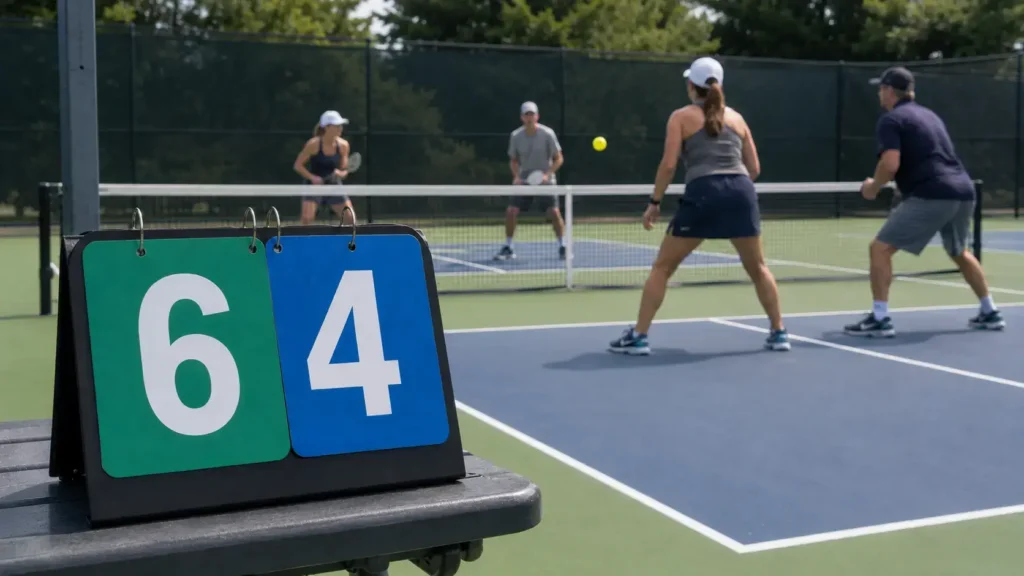

The kitchen trips up more players than any other pickleball rule. You’ll see it happen constantly: someone makes a great shot, forgets about momentum, and commits a fault.
This guide explains what the kitchen is, the pickleball kitchen rules every player should know, the most common faults, and simple strategies for using the kitchen to your advantage. If you’re still learning the basics, our guide on how to play pickleball for beginners walks through the game from start to finish.
What is the Kitchen in Pickleball?
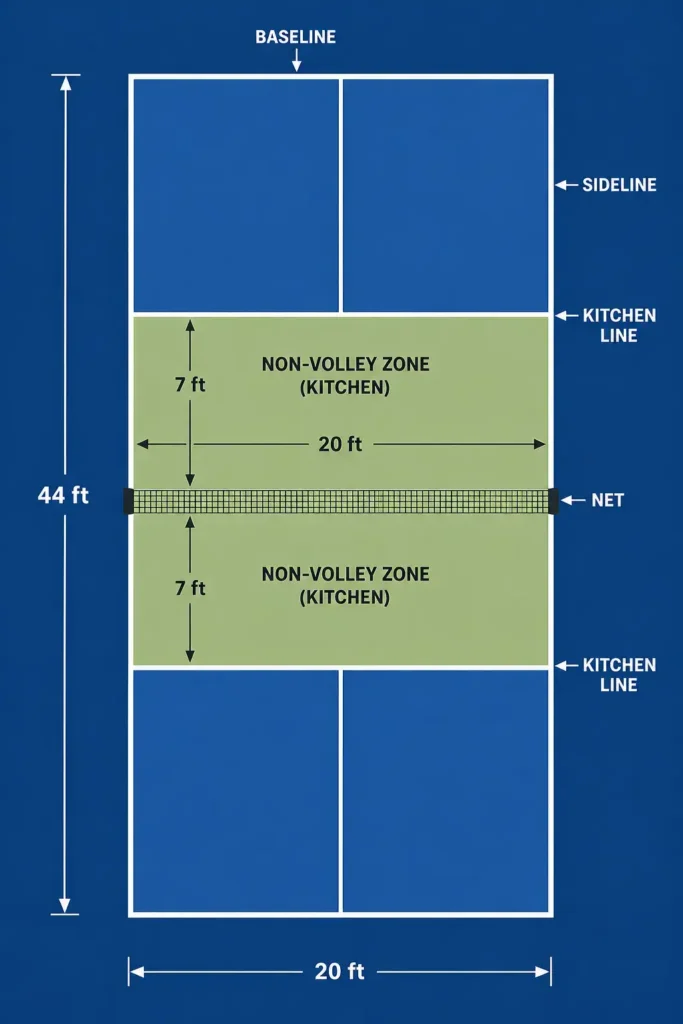
The pickleball kitchen, officially called the non-volley zone (NVZ), is the 7-foot-deep, 20-foot-wide area on each side of the net. You cannot volley (hit the ball before it bounces) while any part of your body, paddle, or clothing is touching the kitchen or its line. If you do, it’s a fault. You can stand in it any time or step in it to play a ball that has already bounced.
How Big Is the Kitchen in Pickleball?
The pickleball kitchen is 7 feet deep and 20 feet wide on each side of the net. It extends the full width of the court, from sideline to sideline.
| Measurement | Size |
| Depth (distance from the net) | 7 feet |
| Width (sideline to sideline) | 20 feet |
| Area on each side | 140 square feet |
Does the Kitchen Line Count as the Kitchen?
Yes, the kitchen line is part of the non-volley zone, so touching it while volleying is a fault. A toe on the line counts the same as your entire foot inside the kitchen.
This also includes the portions of the sidelines that border the kitchen, not just the front line most players think of as the “kitchen line.” The non-volley zone ends at the sidelines, which is what makes an Erne possible. A player can establish position outside the sideline and volley near the net without touching the kitchen.
Why Does the Kitchen Exist?
The kitchen prevents players from crowding the net and smashing volleys from close range, where they would be extremely difficult to return.
It also helps create the strategic style pickleball is known for. Dinks, third shot drops, and patient exchanges are the result of players having to stay behind the kitchen line when volleying.
Core Kitchen Rules in Pickleball
Everything about the kitchen starts with one simple rule: you cannot volley while touching the non-volley zone. Most kitchen rules are just clarifications of what counts as a volley, what counts as touching the kitchen, and how momentum affects the call.
What Counts as a Volley?
A volley in pickleball is any ball hit out of the air before it bounces. The kitchen only restricts shots hit before the bounce. Once the ball has bounced, you can hit it from anywhere on the court, including from the middle of the kitchen, and you can hit it as hard as you want.
When Can You Step Into the Kitchen?
You can step into or stand in the kitchen at any time, as long as you aren’t volleying the ball.
If the ball bounces in the kitchen, you can step in and play it normally. You can even enter the kitchen before the ball bounces, as long as you wait for the bounce before hitting it.
Re-Establishing Both Feet Outside the Kitchen
After you’ve been in the kitchen, both feet must make contact with the playing surface completely outside the zone before you can volley again. One foot outside while the other is still touching the kitchen or its line isn’t enough.
You also can’t stand in the kitchen, jump into the air, volley the ball, and then land outside. Your feet never re-established contact outside the kitchen before the volley, so it’s still a fault.
What Counts as Touching the Kitchen?
During a volley, you can’t touch the kitchen with any part of your body or anything you’re wearing or carrying. That includes:
- Either foot, including a toe touching the kitchen line
- Your hand or knee if you touch the court to catch your balance
- Your paddle, if it touches the surface inside the zone or the line
- Clothing or accessories you’re wearing, such as a hat or sunglasses
If any of these touch the kitchen while you’re volleying, it’s a fault. The restriction isn’t limited to your feet.
Can You Reach Over the Kitchen Line?
Yes, you can reach over the kitchen line to volley the ball. The kitchen is a two-dimensional area on the court and does not extend above the playing surface.
You can lean forward and reach your paddle across the kitchen line to volley as long as you don’t touch the kitchen or its lines. Simply breaking the vertical plane above the kitchen is not a fault.
How Does the Pickleball Momentum Rule Work?
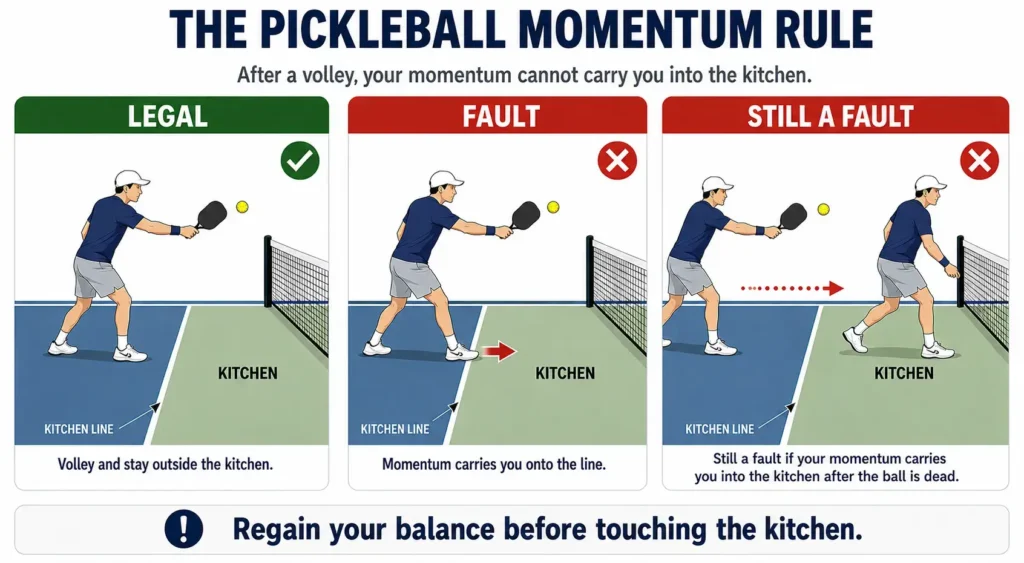
If you volley from outside the kitchen but your momentum carries you into it, it’s a fault, even if the shot would have been a winner. The act of volleying continues until the movement from your follow-through stops.
You might volley with both feet safely behind the kitchen line, then take a step forward and touch the line while trying to regain your balance. That’s still a kitchen fault because your momentum from the volley carried you into the non-volley zone.
The same rule applies to a jump volley. You can jump from outside the kitchen and volley while you’re in the air, but your momentum cannot carry you into the kitchen when you land.
When Does the Volley Start and Stop?
The act of volleying begins when you strike the ball out of the air, and ends when the movement from your follow-through stops.
What If the Ball Is Already Dead?
It’s still a fault if your momentum from a volley carries you into the kitchen after the ball is dead. Momentum violations in the non-volley zone are an exception to the general rule that faults occur only while the ball is live.
If you hit a winner and then stumble onto the kitchen line while you’re still trying to regain your balance, you lose the rally you just won.
Momentum ends once you’ve regained balance and control of your motion or stopped moving toward the kitchen. After that, you can step into the kitchen without committing a fault.
Can Your Partner Stop You From Falling Into the Kitchen?
Yes, your partner can stop your momentum from carrying you into the kitchen, as long as they aren’t touching the non-volley zone.
If your partner is standing outside the kitchen, they can grab your arm or shirt to keep you from falling in. There is no fault simply because your partner helped you regain your balance.
However, if your partner is touching the kitchen when you make contact with them, it’s a fault. The momentum rule treats contact with a partner who is touching the kitchen the same as contacting the kitchen yourself.
Why is it Called “The Kitchen”?
No one knows for certain where the nickname came from. The most common theory is that pickleball borrowed the term from shuffleboard, where “the kitchen” refers to a penalty area.
The name stuck, but “kitchen” remains an informal nickname. The official name is the non-volley zone (NVZ).
Putting the Kitchen Rules Into Practice
The kitchen rules can seem complicated at first, but the basic idea is simple: you can enter the kitchen whenever you want, but you can’t volley while touching it.
Once you understand what counts as a volley, where the kitchen boundaries are, and how momentum works, most kitchen calls become much easier to recognize. Keep these rules in mind at the kitchen line, and you’ll spend less time worrying about faults and more time focusing on the point.
Frequently Asked Questions about the Kitchen Rules in Pickleball
Can you stand in the kitchen in pickleball?
Yes, you can stand in the kitchen whenever you want. The kitchen itself isn’t off limits. The restriction is that you cannot volley while standing inside the kitchen or on the kitchen line. You can also enter the kitchen to hit a ball after it has bounced.
Can the ball bounce in the kitchen in pickleball?
Yes, the ball can bounce in the kitchen after the initial serve. The kitchen restricts where you can hit a volley, not where the ball itself can bounce. After the ball bounces in the kitchen, you can step into the zone and return it normally.
Can you serve into the kitchen in pickleball?
No, a pickleball serve cannot land in the kitchen or on the kitchen line. The serve must clear the non-volley zone and land in the diagonally opposite service court or it is a fault.
Does the return of serve have to clear the kitchen?
No, the return of serve does not have to clear the kitchen. Unlike the serve, a return can legally land in the opponent’s non-volley zone. Regardless of where the return lands, the serving team must let it bounce before hitting it because of pickleball’s two-bounce rule.
What Happens If You Break the Kitchen Rules?
Breaking a kitchen rule results in a fault and immediately ends the rally. If the serving team commits the fault, it loses the serve or moves to the next server in doubles. If the receiving team commits the fault, the serving team scores a point under traditional side out scoring.
All rules on this page were verified against the Official USA Pickleball Rulebook for 2026.