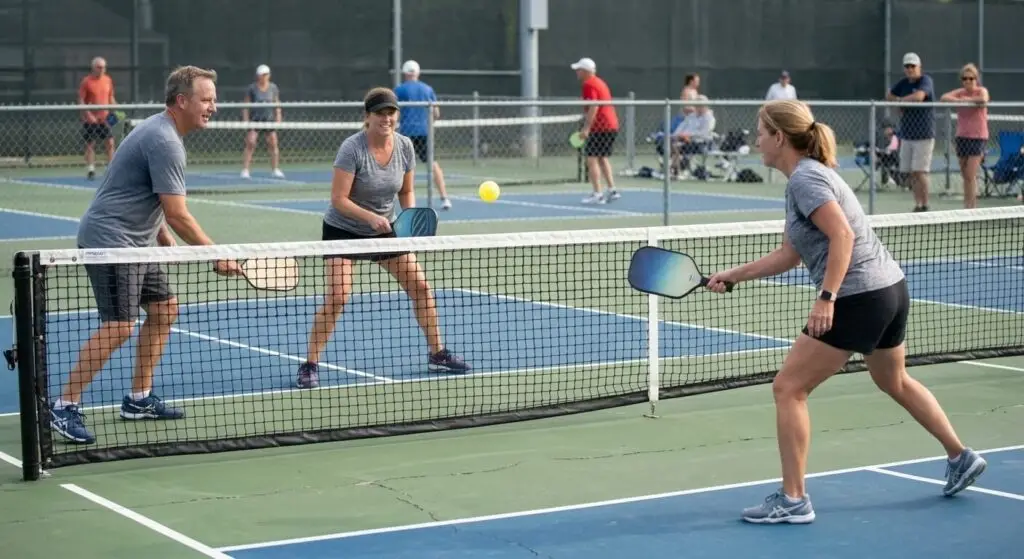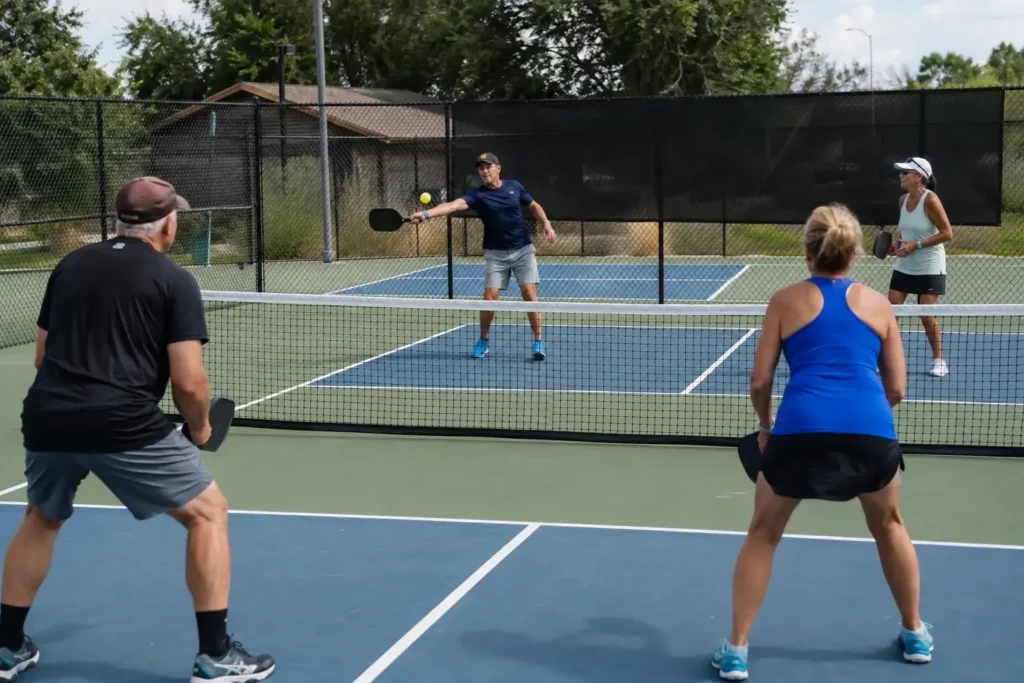
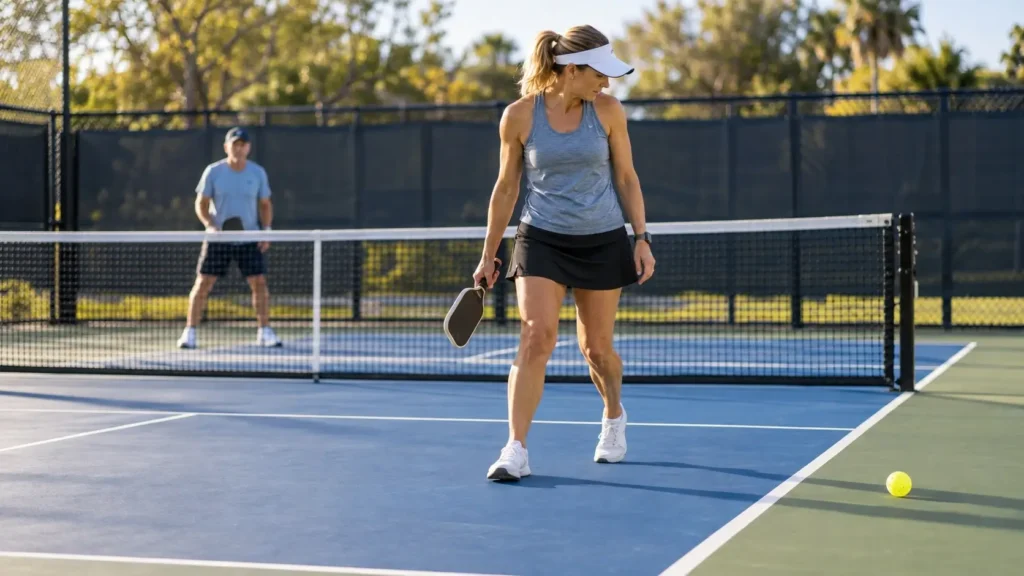
Pickleball faults can happen during the serve, at the kitchen, or at almost any point during a rally. Here are the most common faults under the 2026 Pickleball rules, what causes them, and what happens when you commit one.
- What Is a Fault in Pickleball?
- Serving Faults in Pickleball
- Kitchen and Non-Volley Zone Faults
- Two-Bounce Rule Violations vs Double-Bounce Faults
- Other Common Rally Faults
- What Happens When You Commit a Fault?
- Common Pickleball Faults at a Glance
- Avoiding Pickleball Faults
- Frequently Asked Questions About Pickleball Faults
What Is a Fault in Pickleball?
A fault in pickleball is a rule violation that results in a dead ball and the offending player or team losing the rally.
Most faults occur while the ball is live, although there are exceptions. They can happen during both the serve and a rally, with common violations including illegal serves, kitchen violations, breaking the two-bounce rule, hitting the ball out, and touching the net while the ball is live.
Serving Faults in Pickleball
A serving fault in pickleball, sometimes called a service fault, occurs when the server violates a rule related to their position, serving motion, or where the serve lands.
Foot Faults
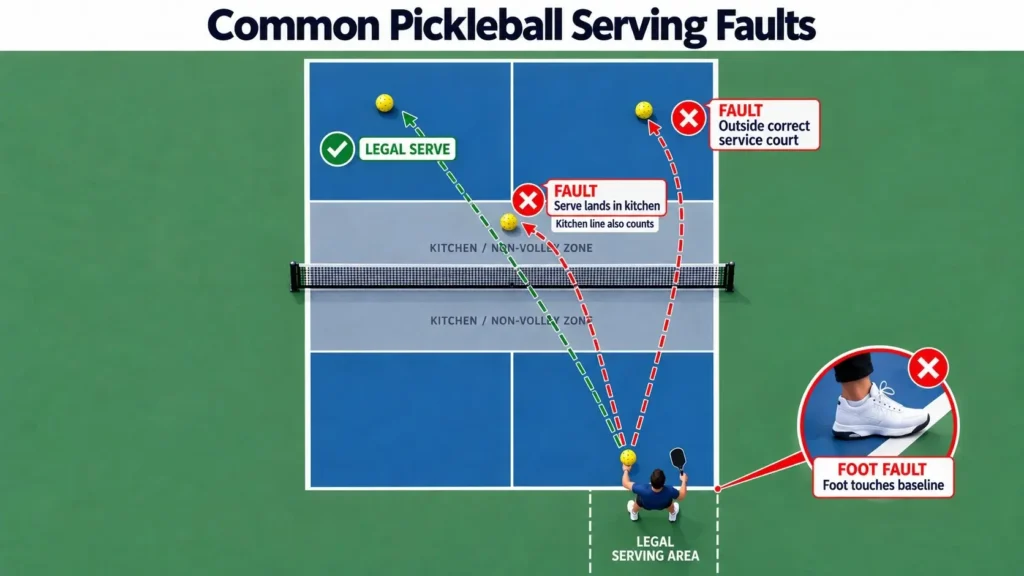
A foot fault occurs when the server’s feet are not legally positioned when the ball is served. Since the baseline is part of the court, both feet must stay behind the baseline, with at least one foot on the ground when the ball is hit. The server’s feet must also stay between the imaginary lines extending back from the sideline and centerline of the service area.
Serve Placement Faults
A serve placement fault occurs when the serve fails to land in the correct service court. The serve must travel diagonally across the net, clear the non-volley zone, and land in the service court opposite the server.
A serve is a fault if it lands outside the correct service court or in the non-volley zone. The kitchen line is part of the non-volley zone, so a serve that lands on the kitchen line is out.
Note: a serve that touches the net is not automatically a fault. If it clears the non-volley zone and lands in the correct service court, the serve is still in play.
Illegal Serving Motions and Ball Releases
A serve fault can occur when the server uses an illegal serving motion or releases the ball incorrectly.
Players can choose to use either a volley serve or a drop serve. For a volley serve, the paddle must move in a clear upward arc when it contacts the ball. The highest point of the paddle head must clearly be below the highest part of the wrist joint, and the ball must clearly be no higher than the server’s waist at contact.
For a drop serve, the ball must be released from a natural, unaided height and cannot be thrown or propelled before it bounces.
Regardless of which serve is used, the server cannot intentionally add spin to the ball when releasing it, although natural rotation during the release is allowed.
Kitchen and Non-Volley Zone Faults
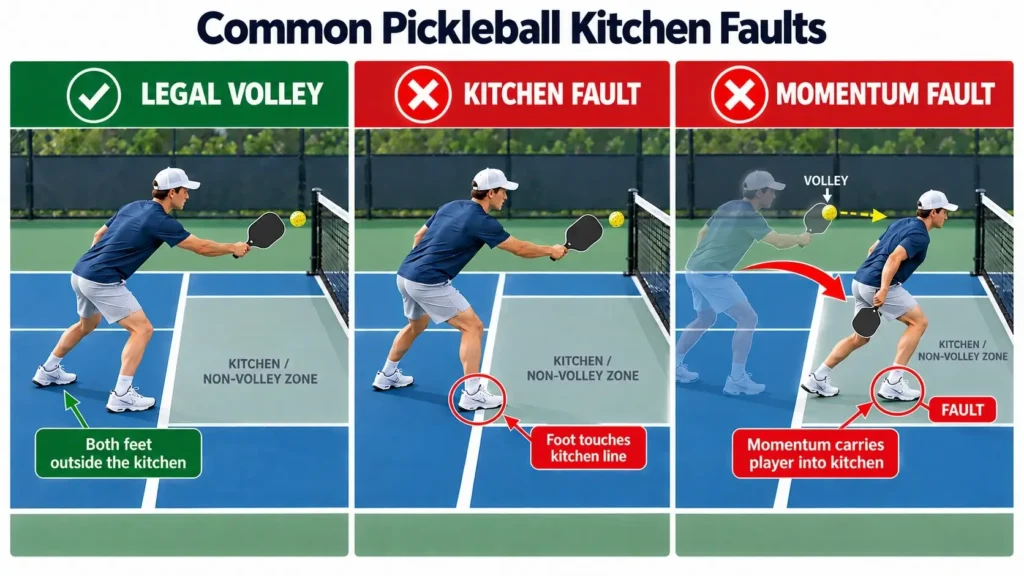
A kitchen fault occurs when a player volleys the ball while touching the kitchen line or standing in the non-volley zone. You can also commit a kitchen fault if you volley from outside the zone but your momentum carries you into it afterward. Even if the ball is already dead, it’s still a fault if your momentum from the volley carries you into the kitchen.
Simply standing in the kitchen is not a fault. However, under the kitchen rules, if you’ve been standing in the kitchen, both feet must re-establish contact completely outside the zone before you can volley. Jumping from inside the kitchen and volleying while airborne still violates the rule and results in a fault.
Two-Bounce Rule Violations vs Double-Bounce Faults
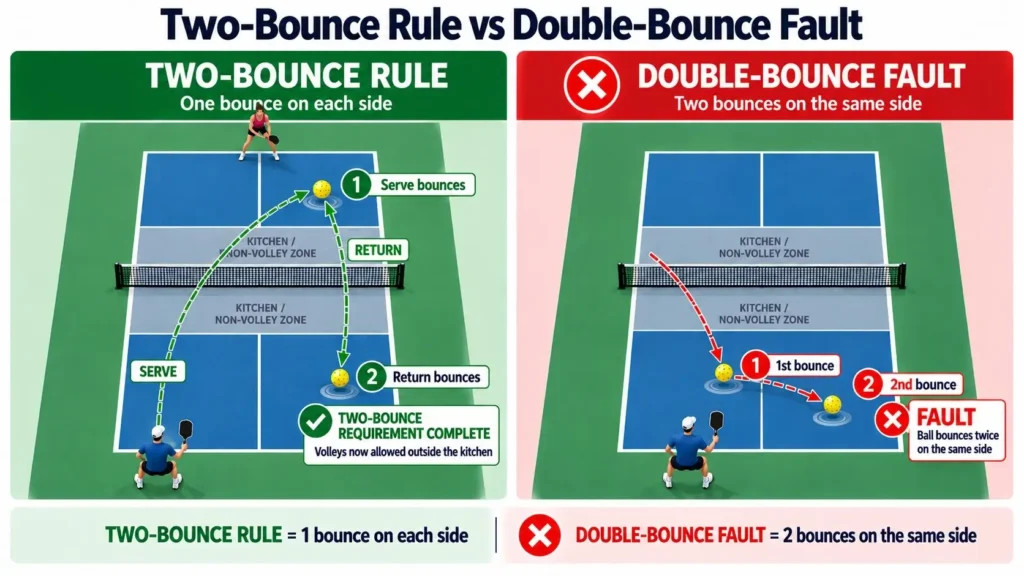
The two-bounce rule and a double-bounce fault both involve the ball bouncing, but they refer to different situations during a rally.
Under the two-bounce rule, the receiver must let the serve bounce before returning. The serving side must then let the return bounce before hitting it. Volleying either shot before the required bounce results in a fault.
After these two required bounces, players can begin volleying normally, provided they follow the non-volley zone rules.
A double-bounce fault occurs when the ball bounces twice on the same side before a player returns it.
Other Common Rally Faults
Once the serve and two-bounce requirements are complete, faults can still occur throughout the rally based on where the ball lands, what it touches, and how a player returns it.
Hitting the Ball Out of Bounds
Hitting the ball out of bounds results in a fault if it first lands outside your opponent’s court. The baseline and sidelines count as in, so a ball that touches either line is not out.
Hitting the Ball into the Net
Hitting the ball into the net is a fault if the ball fails to cross the net and lands back on your side of the court. However, the ball touching the net is not automatically a fault. If the ball touches the net but still crosses to your opponent’s side, the rally continues.
Ball Hits a Player
If the ball hits you in pickleball during a live rally, it’s a fault against you. The same applies if the ball hits anything you’re wearing or carrying.
The main exception is the paddle hand. The ball can legally contact the hand below the wrist while that hand is in contact with the paddle.
Double Hits and Carries
A double hit in pickleball isn’t always a fault. The ball can legally make multiple contacts with the paddle if they occur during one continuous stroke in a single direction by one player.
A double hit outside of this type of stroke is a fault. It’s also a fault if both partners hit the ball while attempting to return it.
Catching or carrying the ball on the paddle during a rally is also a fault.
What Happens When You Commit a Fault?
When you commit a fault in pickleball, your team loses the rally.
Under standard scoring, only the serving team can score, so if the receiving team commits a fault, the serving team wins the rally and scores a point.
If the serving team commits a fault, it loses the rally. In singles, this results in a side out. In doubles, the serve normally moves from the first server to the second server. When the second server loses a rally, the opposing team gets the serve.
Under the provisional rally scoring option in the 2026 rules, the team that wins each rally scores a point regardless of which team served.
Common Pickleball Faults at a Glance
Here’s a quick recap of some of the most common pickleball faults:
| Fault Type | Example |
|---|---|
| Serving fault | Using an illegal serving motion or serving outside the correct service court |
| Kitchen fault | Volleying while touching the non-volley zone |
| Two-bounce violation | Volleying the serve or return before the required bounce |
| Double-bounce fault | Letting the ball bounce twice on the same side before returning it |
| Out-of-bounds fault | Hitting the ball outside the opponent’s court |
| Net contact fault | Touching the net while the ball is live |
| Illegal double hit | Hitting the ball multiple times outside one continuous legal stroke |
| Ball hits a player | The ball hitting a player or something they’re wearing or carrying |
These aren’t the only faults in pickleball, but they cover many of the situations recreational players are likely to encounter.
Avoiding Pickleball Faults
Pickleball has plenty of rules to learn, but most faults become easy to avoid once you understand when and why they happen. Keep the most common faults in mind while you play, and the rules will start to feel natural before long.
Frequently Asked Questions About Pickleball Faults
Are there double faults in pickleball?
No, there are no double faults in pickleball. Unlike tennis, a player normally gets one attempt to make a legal serve, so a serving fault immediately ends that player’s serve.
In singles, the serve passes to the opponent. In doubles, a fault by the first server passes the serve to their partner, the second server. If the second server faults, the opposing team gets the serve.
Can your foot touch the baseline while serving?
No, your foot cannot touch the baseline when you serve in pickleball. Since the baseline is part of the court, touching it when the ball is served results in a foot fault.
Are the lines in or out in pickleball?
The baseline and sidelines are in bounds in pickleball, so a ball that lands on either line is in.
The kitchen line is slightly different. On a serve, a ball that lands on the kitchen line is out because the line is part of the non-volley zone. During a rally, a ball can legally land on the kitchen line and remain in play.
Can you stand in the kitchen in pickleball?
Yes, simply standing in the kitchen is legal. It becomes a fault if you volley while touching the kitchen, your momentum from a volley carries you into it, or you volley before re-establishing both feet outside the zone.
Is hitting the net a fault in pickleball?
No, the ball can touch the net and remain in play as long as it crosses to your opponent’s side. If the ball fails to cross the net and lands back on your side, or lands out of bounds on your opponent’s side, it’s a fault.
Can you touch the net in pickleball?
No, touching the net while the ball is live results in a fault. This applies if you touch it with your body, clothing, paddle, or anything else you’re carrying.