Pickleball’s two-bounce rule, often called the double bounce rule, is simple once you understand the sequence and one of the essential rules every player needs to know.
What Is the Two-Bounce Rule in Pickleball?
The two-bounce rule in pickleball requires the serve to bounce once on the receiving team’s side and the return of serve to bounce once on the serving team’s side before either team may volley the ball.
That creates two mandatory bounces at the start of every rally:
- The serve must bounce on the receiving side before it is returned.
- The return of serve must bounce on the serving side before it is returned.
Once both required bounces have occurred, either team may volley the ball or play it after a bounce.
How the Two-Bounce Rule Works
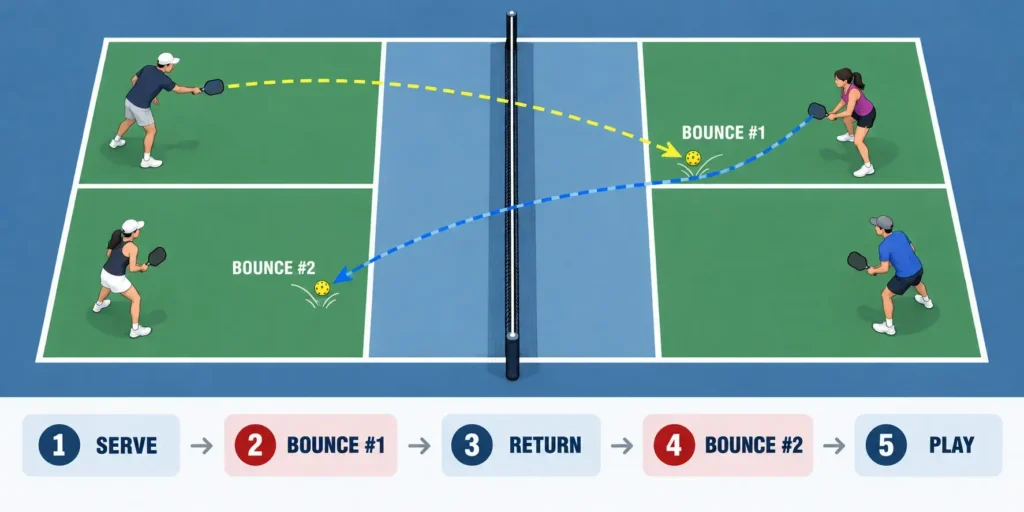
The easiest way to understand the rule is to follow the opening sequence of a rally.
1. Serve and first bounce
Team A serves to Team B. The receiving team must allow the serve to bounce in the correct service court before returning it.
Serve → Bounce #1
2. Return and second bounce
Team B returns the serve to Team A. The serving team must now allow the return to bounce before hitting it.
Return → Bounce #2
3. Normal rally play begins
Once the return has bounced, both required bounces have occurred. From there, either team may volley the ball or play it after a bounce. The non-volley zone, or kitchen, rules still apply to volleys.
A useful way to remember the sequence is:
Serve. Bounce. Return. Bounce. Play.
Can the Second Bounce Be in the Kitchen?
Yes, the second required bounce can land in the kitchen. While a serve must land in the correct service court, the return of serve can land anywhere on the opponent’s court, including in the non-volley zone (kitchen).
The kitchen rules restrict volleying, not balls that bounce there. If the return lands in the kitchen, a player may step in and hit the ball after it bounces.
Why Does Pickleball Have a Two-Bounce Rule?
The two-bounce rule eliminates the serve-and-volley advantage and helps extend rallies. By requiring both the serve and return to bounce, neither team can immediately volley its first shot.
The rule also shapes early-rally strategy, particularly for the serving team, which generally waits for the return to bounce before moving forward. This is where shots such as the third-shot drop can help players transition towards the net.
Two-Bounce Rule vs Double Bounce: What’s the Difference?
The two-bounce rule and double bounce rule are often used interchangeably to describe the required two bounces at the start of a rally. However, a double bounce fault means something different: the ball bounces twice on the same side of the net before being returned.
The two bounces at the start of the rally are required. A double bounce fault occurs when a player fails to return the ball before it bounces a second time on their side.
| Term | Definition | Result |
|---|---|---|
| Two-Bounce Rule | The serve and return each bounce once on opposite sides of the net | Required opening sequence |
| Double Bounce Fault | The ball bounces twice on the same side before being returned | Fault, rally ends |
Exception: Players using wheelchairs and players with certain disabilities may allow the ball to bounce twice before returning it, subject to the adaptive play rules.
Get the Two-Bounce Rule Down and Start Playing
The two-bounce rule can seem confusing at first, but the sequence is simple: serve, bounce, return, bounce, play. Once you get used to letting those first two shots bounce, it quickly becomes a natural part of every rally.
Frequently Asked Questions about the Two-Bounce Rule
Can the ball bounce twice on one side in pickleball?
No, a player must return the ball before it bounces a second time on their side; otherwise, it is a double bounce fault.
Is the two-bounce rule also called the double-bounce rule?
Yes, the two-bounce rule is commonly called the double-bounce rule, although USA Pickleball uses “Two-Bounce Rule” as the official term. A double bounce fault is different and occurs when the ball bounces twice on the same side before being returned, ending the rally.
Does the two-bounce rule apply in both singles and doubles?
Yes, the two-bounce rule applies in both singles and doubles pickleball. In either format, the serve must bounce before being returned, and the return must bounce before the serving player or team hits it.
What happens if a player violates the two-bounce rule?
Violating the two-bounce rule is a fault that ends the rally. Under traditional scoring rules, the serving team scores a point if the receiving team commits the fault, while a fault by the serving team results in loss of serve or, in doubles, a side out when the second server is serving.