Under the 2026 USA Pickleball rules, rally scoring is a provisional scoring option for both singles and doubles. Pickleball rally scoring can create more predictable game lengths than traditional side-out scoring because every rally results in a point.
What Is Rally Scoring in Pickleball?
Rally scoring in pickleball is a scoring format where a point is awarded after every rally, regardless of which player or team served. If the serving team wins the rally, it scores a point and continues to serve. If the receiving team wins, it scores a point and takes over the serve.
That’s the main difference from traditional pickleball scoring, where only the serving side can score.
How Does Rally Scoring Work in Doubles?
In doubles pickleball rally scoring, each team has only one server before the serve passes to the opposing team. If the serving team loses a rally, the receiving team scores a point and immediately takes over the serve. Unlike traditional doubles scoring, there is no second server before the side out.
When a team gains the serve, the player correctly positioned on the right side serves first. If the serving team wins the rally, the same player continues serving from the opposite service area. The server alternates between the right and left service areas as the team wins points.
Player positioning is based on the team’s score. The player who started the game as the team’s starting server is positioned on the right when the team’s score is even and on the left when the score is odd, with their partner in the opposite position.
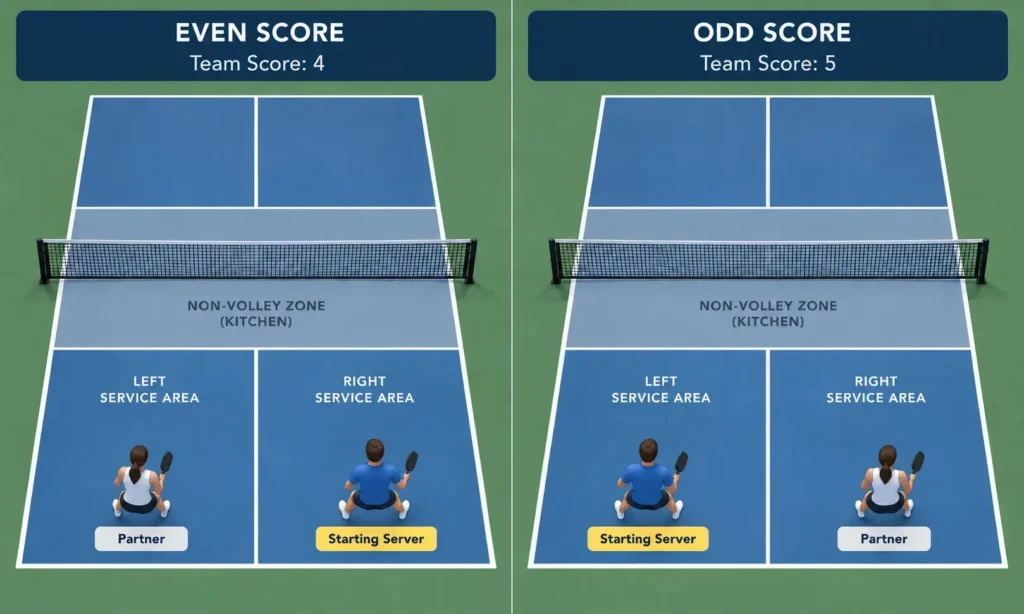
Rally scoring also uses a two-number score in doubles, with the serving team’s score called first and the receiving team’s score second. Traditional doubles scoring uses a third number to identify the first or second server, but that isn’t needed in rally scoring since there is only one server before a side out.
Pickleball Rally Scoring Example
Here’s an example of how the score changes over several rallies:
| Rally | Rally Winner | Team A Score | Team B Score | Serving Team | Score Called |
|---|---|---|---|---|---|
| Game Start | 0 | 0 | Team A | 0-0 | |
| 1 | Team A | 1 | 0 | Team A | 1-0 |
| 2 | Team B | 1 | 1 | Team B | 1-1 |
| 3 | Team B | 1 | 2 | Team B | 2-1 |
| 4 | Team A | 2 | 2 | Team A | 2-2 |
| 5 | Team B | 2 | 3 | Team B | 3-2 |
A point is awarded after every rally. When the serving team wins, it scores a point and continues serving. When the receiving team wins, it scores a point and takes over the serve.
The serving team’s score is always called first. For example, after rally five, Team B leads 3–2 and is serving, so the score is called 3–2.
Rally Scoring vs Traditional Side-Out Scoring
The main difference between rally scoring and traditional side-out scoring is who can score a point. In rally scoring, either side can score, while in traditional side-out scoring, only the serving side can score.
| Rally Scoring | Traditional Side-Out Scoring | |
|---|---|---|
| Who can score? | Either side | Serving side only |
| Point after every rally? | Yes | No |
| Can the receiving side score? | Yes | No |
| Servers in doubles | One per service turn | Two per service turn* |
| Score called in doubles | Two numbers | Three-number score |
| When does a side out occur? | When the serving team loses a rally | After both partners lose their service turn* |
*In traditional doubles side-out scoring, the team that serves first in the game starts with only one server before the first side out. After that, each team gets two servers per service turn.
For doubles players used to traditional side-out scoring, the two biggest adjustments are that every rally affects the score and there is no second server before the serve changes teams.
Is There a Freeze Rule in Pickleball Rally Scoring?
Under the 2026 USA Pickleball rally scoring rules, there is no freeze or serve-to-win requirement.
The player or team that wins each rally scores the point. That includes game point, meaning a receiving team can win the game by winning the rally.
Understanding Pickleball Rally Scoring
Rally scoring is fairly simple once you understand the core rule: every rally awards a point, regardless of which side served. From there, the main adjustments are learning the serving rotation and positioning, particularly when playing doubles, but it quickly becomes second nature once you start playing.
Frequently Asked Questions About Rally Scoring in Pickleball
How Many Points Do You Play to in Pickleball Rally Scoring?
Pickleball rally scoring games can be played to 11, 15 or 21 points, depending on the match format. Games are won by two points, so in a game to 15, a 14–14 tie would continue until one player or team leads by two.
Can the Receiving Team Score in Rally Scoring?
Yes, in rally scoring, the receiving team scores a point when it wins the rally and then takes over the serve.
Is Rally Scoring Used in Singles Pickleball?
Yes, rally scoring can be used in singles pickleball. The player who wins each rally scores a point. If the server loses the rally, the receiving player scores a point and takes over the serve. When serving, an even score means serving from the right side of the court, while an odd score means serving from the left.
Do Partners Switch Sides in Rally Scoring?
In doubles rally scoring, when the serving team scores a point, the server and their partner switch between left and right service areas. If the receiving team wins the rally, it scores a point and gains the serve, but the players do not switch sides.
Is Pickleball Switching to Rally Scoring in 2026?
No, pickleball is not completely switching to rally scoring in 2026. USA Pickleball includes rally scoring as a provisional scoring option for both singles and doubles, while traditional side-out scoring remains the standard scoring system.
What Are the Disadvantages of Rally Scoring in Pickleball?
Potential disadvantages of rally scoring are that every lost rally costs a point and there may be fewer opportunities for large comebacks. Unlike traditional side-out scoring, mistakes made while receiving can directly increase your opponent’s score.
Rules verified against the 2026 USA Pickleball Official Rulebook