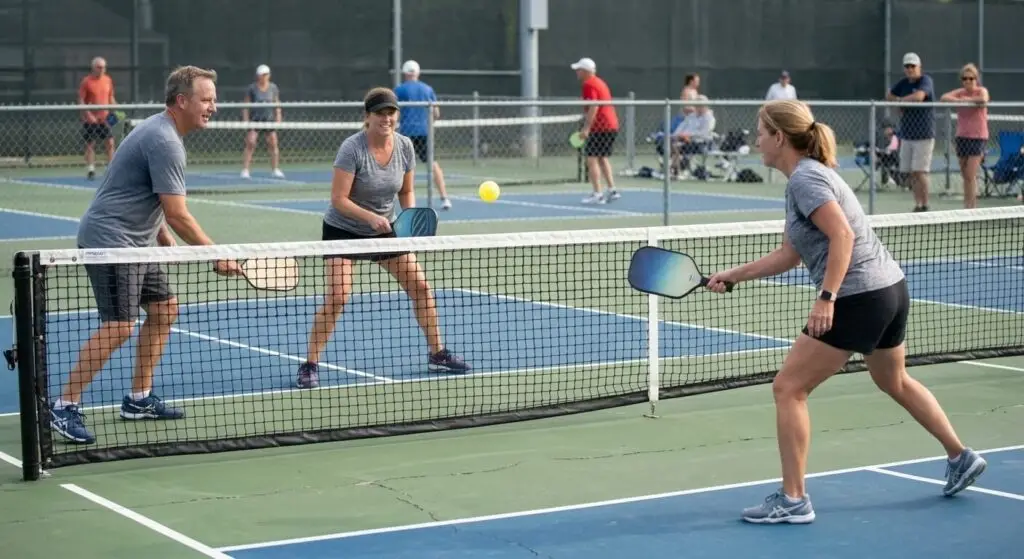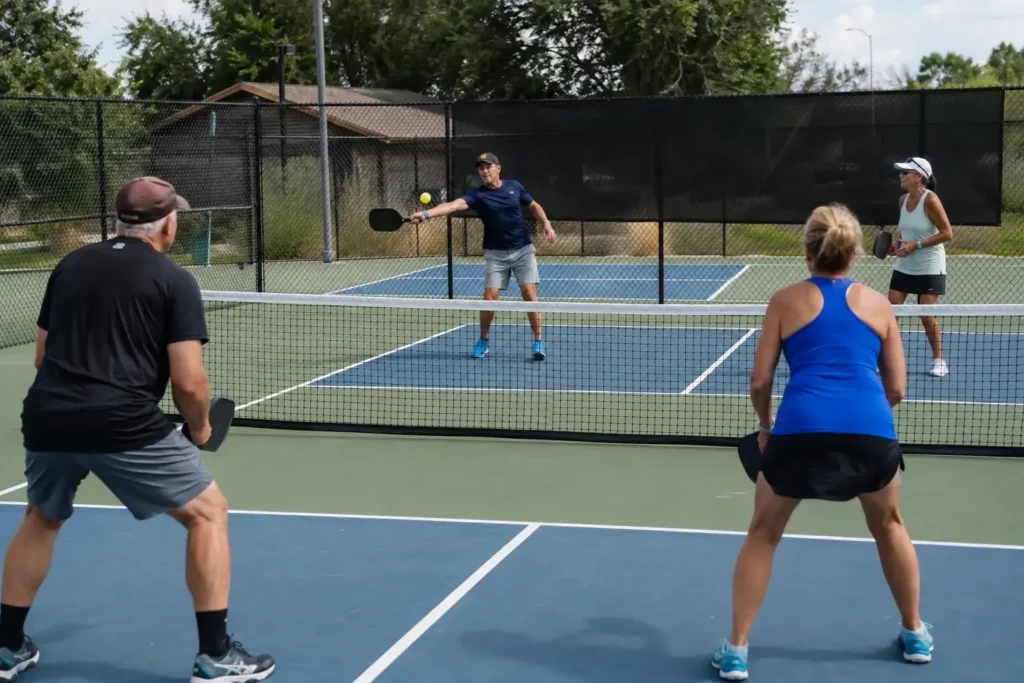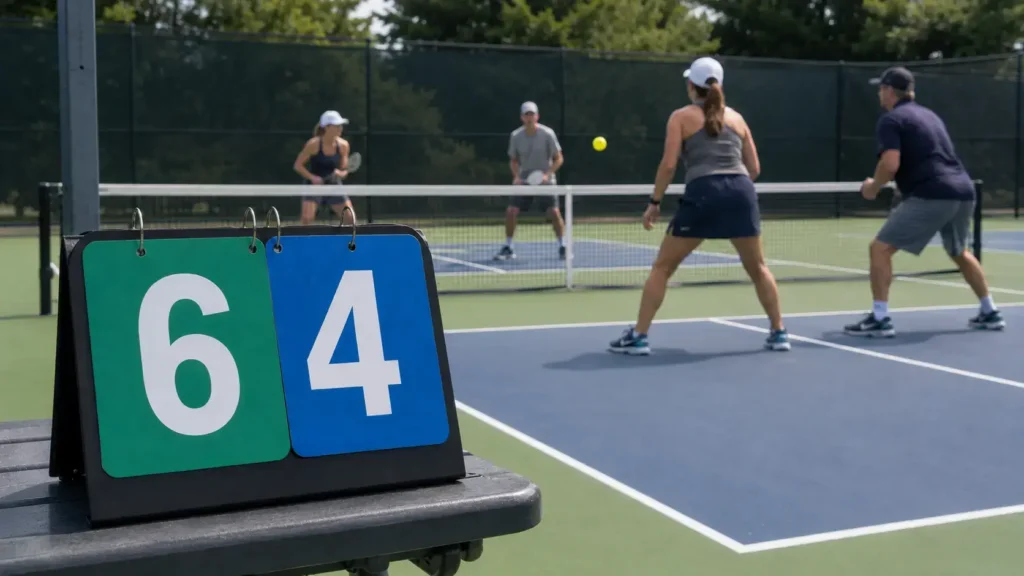

Stepped onto a pickleball court and realized you don’t actually know the rules? It happens to everyone. Pickleball looks simple, and most of it is, but there are a few essential pickleball rules you’ll need to know before you play.
We’ll walk you through the fundamental rules of pickleball in the order they come up in real play, so you can learn the game faster and get out on the court.
If you’re completely new to pickleball and still figuring out basic concepts like what equipment you need or how the game even works, check out our guide to pickleball for beginners first, then come back here for a breakdown of the official rules.
Pickleball Rules in 60 Seconds
If you only remember five things, remember these:
- Serve underhand into the diagonal service box, and the ball must clear the kitchen line.
- Let the ball bounce once on each side after the serve before anyone hits it out of the air. This is the two-bounce rule.
- Never volley while standing in the kitchen (the 7-foot zone on each side of the net which is called the non-volley zone).
- Only the serving team can score points.
- Games are usually played to 11 points, and you must win by 2.
Serving Rules
Before the game starts, players typically decide who serves first with a coin toss, paddle spin, or another agreed-upon method.
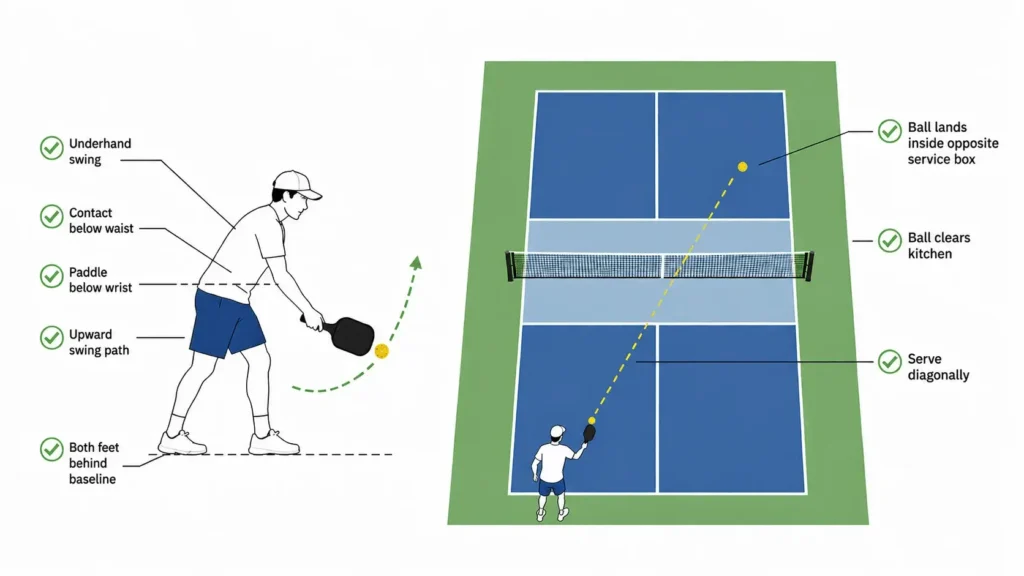
The serve starts every rally, and it’s one of the easiest ways to lose a point before it begins. To keep your serve legal, follow these rules:
- All serves are underhand. No overhead serves are allowed.
- Contact with the ball must be made below your waist (around navel level)
- The paddle head must be below your wrist at the moment you strike it
- Your arm must be moving in an upward arc through contact
- At least one foot must stay on the ground behind the baseline until you hit the ball.
- Serve diagonally into the opposite service court
- The ball must clear the kitchen line and land inside the correct service box
- You get one serve attempt. You don’t get a second chance if you miss it or the ball lands incorrectly.
You can choose between two serve styles. The first is a volley serve, where you hit the ball out of the air after releasing it from your hand. The second is a drop serve, where you drop the ball, let it bounce, and then hit it.
Many beginners choose to use a drop serve during their first few games because the paddle height rules don’t apply to it. Instead of hitting the ball out of the air, you drop the ball, let it bounce, and then hit it without worrying about the “below the waist, paddle below the wrist” requirements.
Tip: The most common mistake beginners make while serving is with their feet. At least one foot must stay behind the baseline until the ball is hit, and neither foot can touch the baseline or inside the court before contact. Step on the line too early and your turn to serve is over.
Two-Bounce Rule
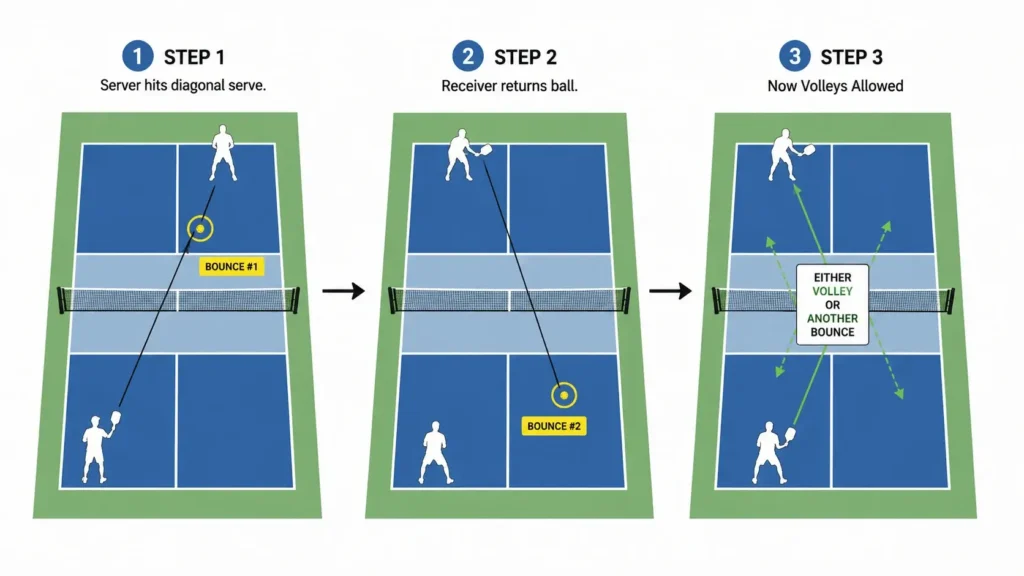
The two-bounce rule (sometimes called the double-bounce rule) requires the ball to bounce once on each side of the net before either team can hit a volley.
It works in two steps:
- The return of serve must bounce before the returning team hits it
- The serving team’s next shot (the third shot of the rally) must bounce before they hit it
Two bounces, then the rally opens up and anyone can volley the ball or let it bounce before returning it.
Why does this exist? It stops the serving team from rushing the net right away and stops the returner from crushing a volley. The result is longer rallies and a fairer start.
The two-bounce rule also affects court positioning, especially after the serve. If your partner is serving, don’t immediately rush up to the kitchen. The returner can drive the ball straight at you, and if you instinctively volley it before it bounces on your side, you’ve committed a fault.
Instead, the serving team should stay behind the baseline until the return has bounced.
The Kitchen: Non-Volley Zone Rules
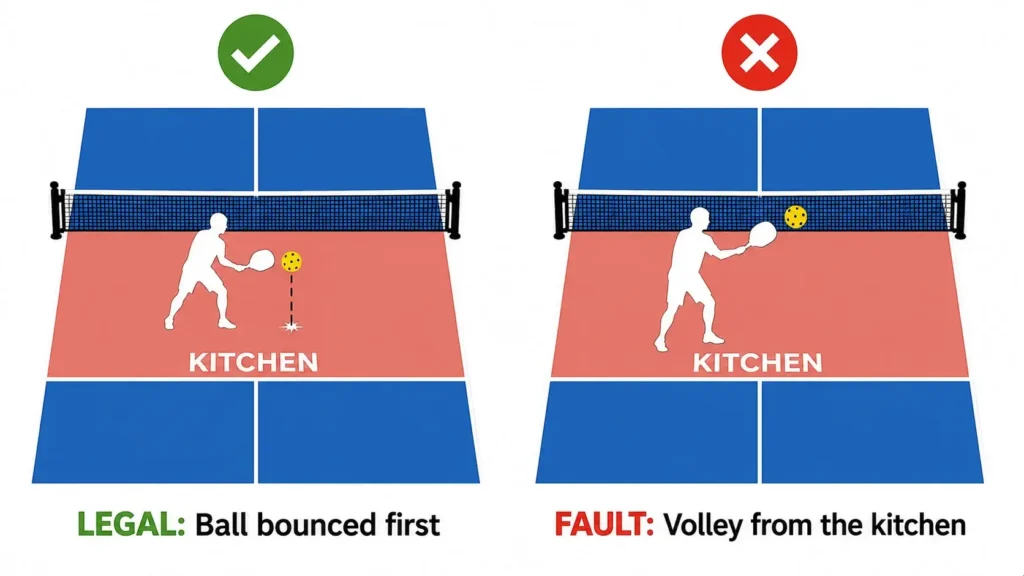
The non-volley zone, commonly referred to as the kitchen, is the 7-foot zone next to the net on both sides. Understanding the pickleball kitchen rules starts with knowing when you can enter the zone and when you can volley from it.
The rule is simple: you cannot hit a volley (a ball out of the air) while any part of you is touching the kitchen or the kitchen line. The kitchen line is considered part of the kitchen, so touching it during a volley is also a fault. That includes your feet, paddle, and anything you are wearing or carrying.
You must be careful, because if you volley the ball and your momentum carries you into the kitchen afterward, it is still a fault, even if the ball is already dead and the point is over.
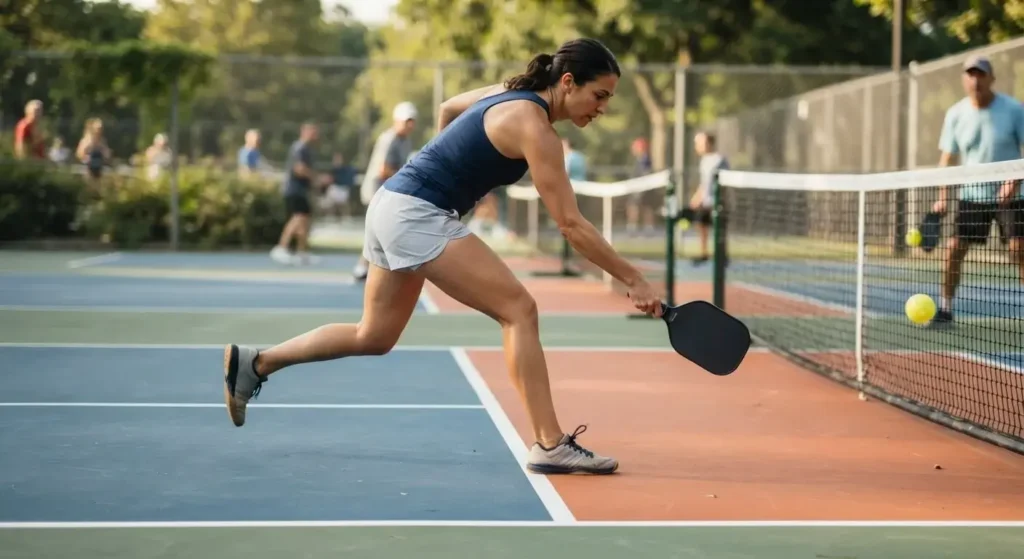
Despite the restrictions, you’re still allowed to:
- Step in anytime to play a ball that has already bounced there
- Stand in the kitchen between shots (it’s just a bad idea strategically)
- Reach across the line to volley a ball, as long as your feet don’t cross
Why does this rule exist? The kitchen prevents players from standing right at the net and smashing every ball out of the air. Without it, rallies would often end after a single powerful volley instead of the longer exchanges that make pickleball unique and exciting. The rule rewards patience, positioning, and shot placement instead of raw power.
Remember this one rule: Kitchen groundstrokes are legal. Kitchen volleys are not. Remember that distinction and you will avoid the most common beginner fault in the sport.
Scoring Rules
The pickleball rules for scoring trip up more beginners than any other part of the game.
Most games use traditional side-out scoring, which follows two simple rules:
- Only the serving team can score a point
- Games go to 11 points, and you have to win by 2
Some tournament games are played to 15 or 21 points, but the “win by 2” rule still applies.
Note: There’s a newer format called rally scoring where either team can score, no matter who served. It’s faster and is used in some leagues and tournaments, but traditional side-out scoring is still the most common format.
Doubles Scoring Using the Three-Number Scoring System
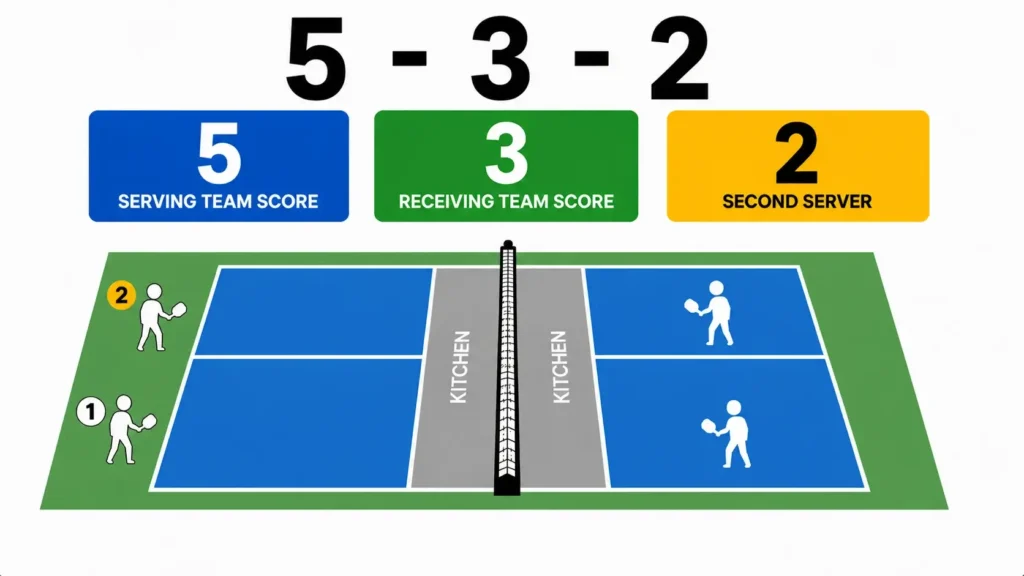
In doubles, the score is announced as three numbers before every serve:
- The serving team’s score
- The receiving team’s score
- Which server you are: 1 or 2
So “5-3-2” means the serving team has 5 points, the receiving team has 3, and the second server is up.
Both players on a team get a chance to serve before the serve passes to the other team. Each time the serving team wins a rally, the server switches service courts with their partner and serves again.
When that server commits a fault, their partner becomes the second server. If the second server also faults, it’s a side-out and the other team gets to serve.
The only exception happens at the start of the game. Instead of getting two servers, the first serving team only gets one. That is why the opening score is called “0-0-2” rather than “0-0-1”. This prevents the first serving team from gaining an extra serving advantage before the other team has a chance to serve.
Singles Scoring
Scoring is simpler when playing singles, and the third number is dropped entirely. You just call two numbers: your score first, then your opponent’s. After each point you score, you serve from the opposite service court (switching between the right and left sides). Once the server commits a fault, the other player becomes the server.
Faults: What Ends a Rally
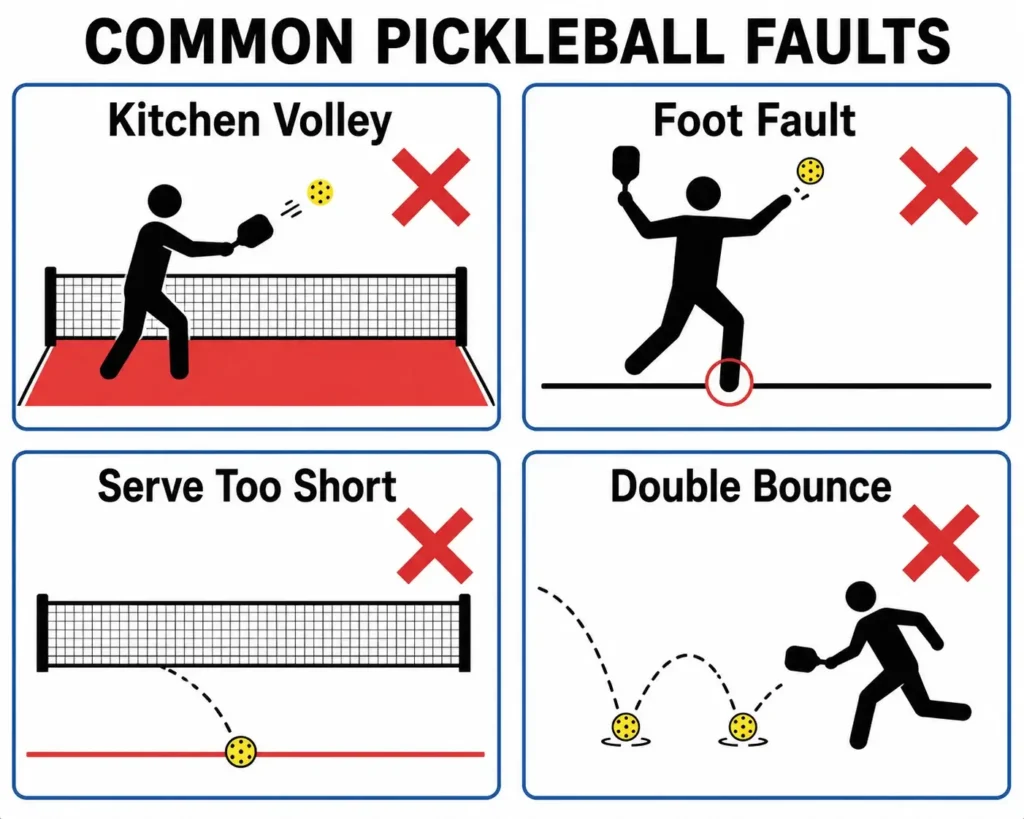
A fault is a rule violation that stops play and ends the rally. A fault by the receiving team gives the serving team a point; a fault by the serving team costs them the serve.
The most common faults are:
- The serve lands in the kitchen, on the kitchen line, or outside the correct service court
- The ball is hit out of bounds (past the baseline or wide of the sideline)
- The ball is hit into the net
- A player volleys before the two-bounce rule has been satisfied
- A player volleys while standing in the kitchen
- The ball bounces twice before someone returns it
- The ball hits you or your clothing
- A player, their clothing, or their paddle touches the net or net post while the ball is in play
In pickleball, balls that land on any lines are “in,” with one exception. A serve that lands on the kitchen line is short, and that is a fault.
The three faults beginners commit most often are stepping into the kitchen after a volley, trying to volley the serve before it bounces, and committing foot faults on the serve. Master those three and you’ll avoid many of the most common mistakes.
Singles vs Doubles Rules
Singles and doubles share the same core rules. The biggest differences are scoring and serve rotation.
In doubles, both players on a team serve before a side-out, except the very first turn of the game. The score is called using the three-number scoring system.
In singles, you serve from the right side when your score is even (0, 2, 4) and the left side when it is odd (1, 3, 5). There is no second server and no server number, so the score call drops to just two numbers: your score, then your opponent’s.
Here’s a quick comparison of the key rule differences:
| Rule Category | Doubles | Singles |
| Score Format | Three numbers (server score, receiver score, server number). Example: 7-5-2 | Two numbers only (server score, receiver score). Example: 7-5 |
| Starting Score | 0-0-2 (team starts with “second server” to balance first-serve advantage) | 0-0 (no server number needed) |
| Service Rotation | Both partners serve before side-out. The first server serves until fault, then the partner takes over. After both fault, opponents serve. | Only one player per side. After fault, immediate side-out to opponent. |
| Serving Position | The server and partner switch service courts after each point won while serving | The server switches sides based on score (right side when even, left side when odd). |
| Court Coverage | Two players cover half-court width each (roughly 10 feet per player). | One player covers the full 20-foot court width. |
Everything else stays the same: the two-bounce rule, kitchen restrictions, serving requirements, and fault conditions all apply identically in both formats.
One practical note: because singles requires more court coverage, rallies often involve more baseline play and fewer kitchen exchanges. But that’s a strategic difference, not a rule difference.
Ready to Play
Pickleball rules are easy to learn once you understand the basics.
By focusing on the serve, respecting the two-bounce rule, staying out of the kitchen when you volley, and memorizing how to keep score, you’ll be ready to play your first game. The more you play, the more these rules become second nature, letting you spend less time thinking about how to play and more time enjoying the game.
Frequently Asked Questions about the Rules of Pickleball
Can you step into the kitchen after the ball bounces?
Yes, you can step into the kitchen anytime to hit a ball that has already bounced there, and you can stand in it between shots.
Can you hit the ball while standing in the kitchen?
You can hit a ball after it has bounced in the kitchen, but you cannot hit a ball out of the air while standing there. If you hit a volley while standing in the kitchen or touching the kitchen line, it will be a fault and the point will be over.
Can you volley the ball?
Yes, but only after the two-bounce rule is met where the ball bounces once on either side and you can’t volley in the kitchen.
Are the lines in or out?
A ball touching a line is “in,” with the exception of a serve that lands on the kitchen line, which is considered short and results in a fault.
Can the ball hit the net during a rally?
Yes, balls can hit the net. As long as the ball goes over and lands in-bounds on your opponent’s side, the ball is still considered live and in play if it hits the net.
Who serves first?
Any fair method can be used to decide who serves first. Players usually use a coin flip or a paddle spin.
Do you get a second serve?
No, if you commit a fault on the serve, your turn is over. The server does not get a second chance.
Is a serve that hits the net replayed?
No, if the ball hits the net and still lands in the correct service box, it is live and you play on. If it does not go over, or does not land in the correct service box, it is a fault.
What happens if the ball hits you?
If the ball touches you or anything you’re wearing, it’s a fault against your team and the rally ends.
Do pickleball rules change for singles?
The core rules stay the same, but the scoring and serve rotation change. Instead of using the three-number system, only your score and your opponent’s score are called. The server’s position depends on whether their score is odd (left side) or even (right side).
How many points is pickleball played to?
Most recreational games are played to 11 points, win by 2. Some tournament formats play to 15 or 21, still requiring you to win by 2 points.
Why is it called the kitchen?
No one knows for certain where the name came from, but the non-volley zone became widely known as the “kitchen.” Today, the two terms mean exactly the same thing.
Can the ball bounce twice?
No. Once the two-bounce rule has been satisfied at the start of the rally, the ball can only bounce once on each side before it must be returned. If it bounces twice, it’s a fault.